

MAJOR TAKEAWAYS
• Enslaved Black Americans helped build the economic foundation of America while being denied basic human rights and freedoms.
• Following emancipation, Black Codes and discriminatory laws were used to restrict opportunities and maintain control over Black labor.
• The 13th Amendment’s exception clause created a pathway for convict leasing, allowing forced labor to continue under a different legal framework.
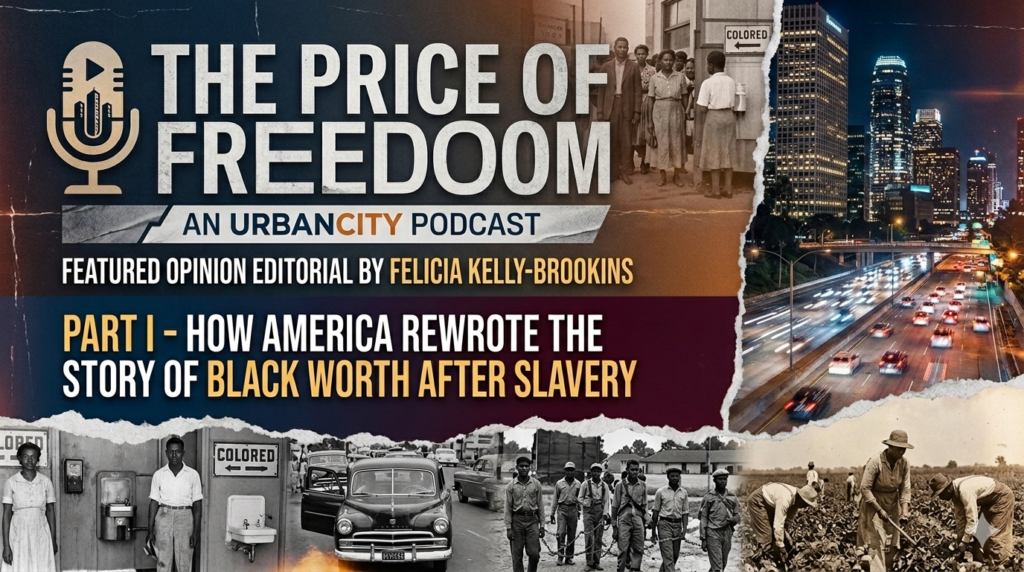
THE PRICE OF FREEDOM
By Felicia Kelly-Brookins• 2 min read
An Urban City Podcast Featured Opinion Editorial
PART I- How America Rewrote the Story of Black Worth After Slavery
There is a question America has spent more than 160 years avoiding, How did a people once
considered valuable enough to build a nation become a people so often viewed with suspicion
inside the nation they helped build? It is a question rooted in history and reflected in policy. And
it is a question that still echoes through courtrooms, classrooms, neighborhoods, businesses, and
headlines today.
For more than two centuries, enslaved Africans and their descendants were considered among
the most valuable commodities in America. Their labor fueled an economy. Their bodies
generated wealth. Their hands built fortunes they would never inherit. Yet, America denied them
freedom, citizenship, education and the right of humanity. Yet somehow, America never denied
their value.
No one questioned whether Black people were hardworking while the nation’s
agricultural economy depended upon their labor. No one questioned their reliability when entire
industries were built on their backs, and no one questioned their productivity when their labor
enriched plantation owners, banks, railroads, merchants, and businesses throughout the country.
Their labor was valuable. Their lives were not. Then slavery ended and something remarkable
happened.
The value assigned to Black labor began to disappear, while the stereotypes assigned
to Black people began to grow. The Civil War ended slavery but it did not end America’s
dependence on controlling Black labor. The emancipation of four million formerly enslaved
people created an economic crisis for those who had built wealth through free labor. Suddenly,
the workforce that had once generated enormous profits could no longer legally be owned.
The solution was not equality; The solution was adaptation. Southern states quickly enacted
Black Codes designed to restrict the movement, employment, and freedoms of newly
emancipated African Americans. Laws were written that criminalized unemployment. They
targeted loitering, vagrancy, movement and the very existence of black people.
Thousands of Black men found themselves arrested not because they were dangerous, but because they were
Black and free in a society struggling to accept either. Then came one of the most overlooked
realities in American history, The 13th Amendment. The 13th Amendment abolished slavery and
involuntary servitude, except as punishment for a crime. That exception became a doorway to
convict leasing in the South .











One Response
Because NOW we must go back to where it began and walk through how we managed to find ourselves back in a ‘time warp’ dealing with certain individuals with racist and bias mindsets and beliefs.