
Major Takeaways
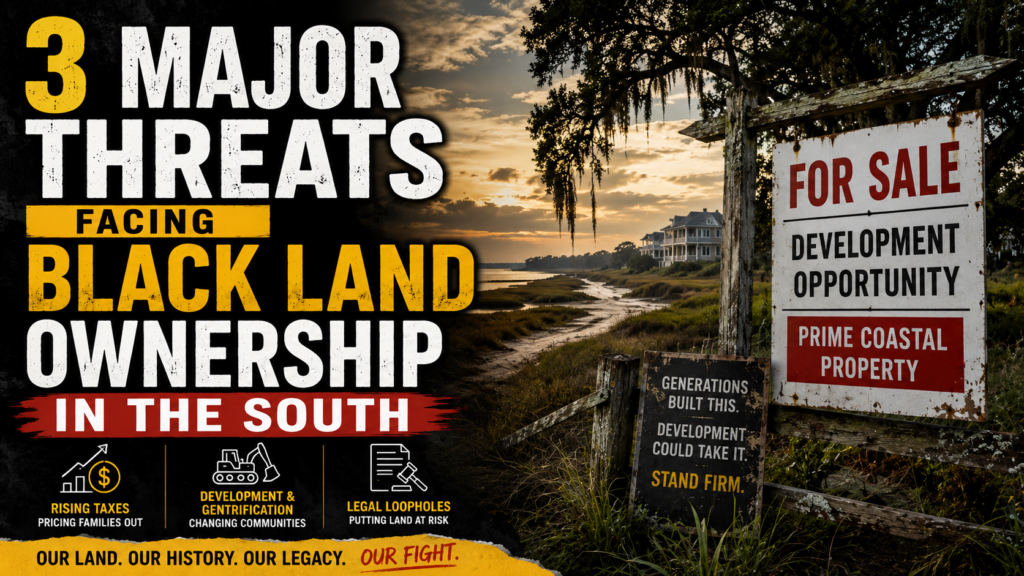
- Rising property taxes and aggressive development are forcing some Black families off land owned for generations.
- Gullah Geechee communities are among the most impacted as coastal Southern land becomes increasingly valuable.
- Legal issues involving heirs’ property laws continue to make Black-owned land vulnerable to outside investors and court-ordered sales.
Rising Taxes, Developers, And Legal Loopholes Threaten Historic Black Communities
By Urban City Digital News Desk• 5 min read
For many Black families across the South, that land represents survival. It represents freedom after slavery. It represents grandparents who worked fields barefoot, saved pennies during segregation, and bought acres nobody else wanted at the time. Today, that same land is worth millions and suddenly everybody wants it.
Nowhere is that battle more visible than in the historic Gullah Geechee communities stretching from North Carolina to Florida. Families whose roots trace directly back to enslaved Africans are watching developers, rising property taxes, tourism expansion, and legal pressure slowly chip away at land that has stayed in their bloodlines for generations.
And many people are asking the same question:
Is this development… or is this displacement with a fresh coat of paint?
The Gullah Geechee people have preserved one of the most unique Black cultures in America for centuries. Their traditions, language, food, music, and history survived slavery, Jim Crow, and decades of neglect because many communities remained geographically isolated on coastal islands and rural Southern land.
But isolation became valuable.
Beachfront property. Coastal tourism. Luxury homes. Resorts. Corporate investment.
What used to be overlooked land is now prime real estate.
And as property values rise, so do taxes.
Some elderly Black landowners who inherited property from parents and grandparents now face tax bills they simply cannot afford. Others are pressured into selling land through aggressive offers from developers. In some cases, families lose property through complicated heirs’ property laws legal situations where inherited land has multiple family owners but no clear will or title structure.
That loophole has become a goldmine for outside investors.
One distant relative can sell their small ownership share to a developer, opening the door for court-ordered sales of entire family properties. Families who held land for over 100 years can lose it in months.
That reality has sparked outrage among historians, activists, and Black land preservation groups across the South.
Because this is bigger than property.
This is cultural erasure.
This is economic power disappearing in real time.
For decades, Black Americans were denied opportunities to own homes, businesses, and land through redlining, discrimination, violence, and unequal lending practices. Land ownership became one of the few ways Black families could build wealth and pass something down to the next generation.
Now many communities fear history is repeating itself in a different form.
Not with burning crosses or segregation signs.
But with zoning meetings.
Luxury condos.
Tax assessments.
Corporate buyouts.
And paperwork most families were never taught how to navigate.
Some younger Black leaders are now stepping in to fight back.
Organizations throughout the South are helping families create wills, secure legal titles, fight predatory development, and educate communities about heirs’ property laws. Others are encouraging Black families not to sell inherited land too quickly, especially as Southern property values continue to rise.
And many residents say preserving the land also means preserving Black history itself.
Because once the people leave, the culture usually leaves with them.
You can already see signs of it in some coastal communities once known for strong Black populations. Luxury golf carts replace front porches. Vacation rentals replace family homes. Wealthy transplants move in while descendants of the original landowners are forced farther inland.
The neighborhood still exists physically.
But culturally?
Something is gone.
The fight over Black land ownership is quickly becoming one of the biggest economic and cultural battles happening in America today — even if national headlines barely cover it.
Because at the center of it all is a hard truth:
If you can separate people from their land, eventually you can separate them from their history.
And once history disappears, rebuilding it becomes almost impossible.