

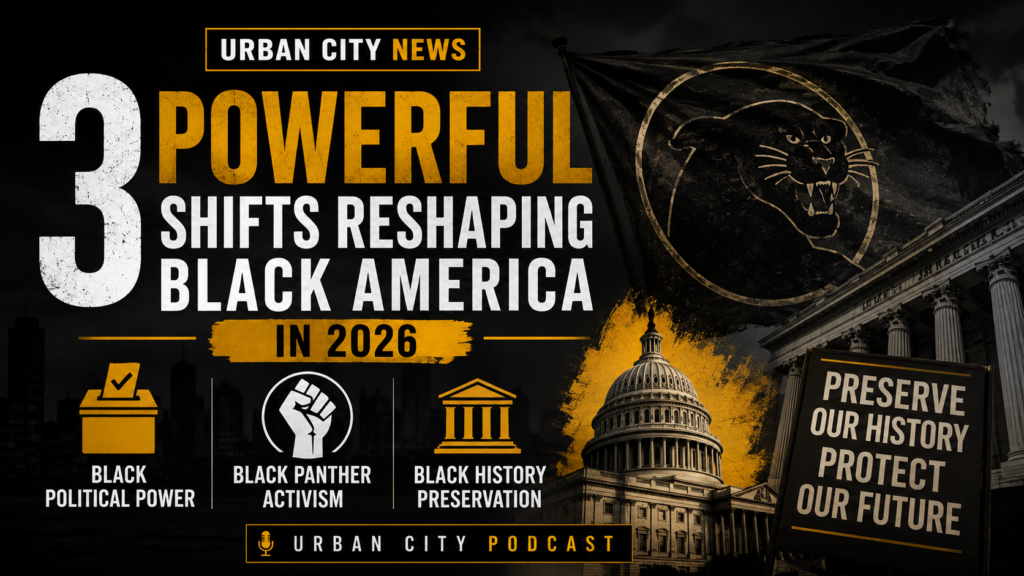
How Black political influence, modern activism, and cultural preservation efforts are redefining the future of Black America in 2026.
Sorry, no results.
Please try another keyword
00:00

This is Urban City News, I’m Kiera Tenay.
Three major developments shaping Black America in 2026. From the growing influence of Black political leadership, to the re-emergence of Black Panther imagery in modern activism, and why Black cultural institutions are now fighting harder than ever to preserve history.
These stories are different on the surface, but connected underneath. Because across the country, many Black communities are asking the same question: Who controls the future of Black identity, Black power, and Black history?
The 2026 election cycle is already becoming one of the most closely watched political moments for Black voters and Black candidates in recent years. Across several states, Black political leaders, particularly Black women, are launching campaigns for Senate seats, mayoral offices, congressional districts, and statewide leadership positions. Political analysts say Black voter turnout could once again become one of the deciding forces in key battleground states.
And while this isn’t new historically, what is changing is the strategy. Many younger Black voters are becoming more issue-focused rather than party-loyal. Topics like affordable housing, student loan debt, policing, healthcare access, economic opportunity, and voting rights are now driving conversations more than traditional political messaging.
Meanwhile, civil rights organizations are continuing legal battles over voting maps and district boundaries in Southern states after multiple court rulings weakened parts of federal voting protections over the past several years. Supporters argue these legal fights are necessary to protect fair representation for Black communities. Critics argue states should have more control over election systems.
Black political influence remains a central force in American elections. And in 2026, both major political parties know they cannot afford to ignore it.
A different kind of political conversation is also growing, this time in the streets, online, and inside activist spaces. Across social media and community demonstrations, imagery connected to the historic Black Panther movement is becoming more visible again.
Younger activists are using symbols associated with the Black Panthers, including black berets, community defense language, and survival-program messaging, to draw attention to issues like police accountability, food insecurity, neighborhood safety, and economic inequality.
Historians note that the original Black Panther Party, founded in Oakland in 1966, became nationally known for both armed self-defense patrols and community-based programs like free breakfast initiatives and health clinics. Today’s activism is not identical to the original movement, but experts say many younger organizers are inspired by the Panthers’ focus on self-determination, political education, and direct community action.
At the same time, the imagery remains controversial. Some critics argue the symbolism can increase political division or create public fear because of the Panthers’ historic confrontations with law enforcement during the civil rights era. Others say the renewed interest reflects frustration from younger generations who feel traditional political systems have failed to fully address long-standing racial and economic disparities.
For many activists, the message is less about militancy and more about visibility, empowerment, and community protection.
And finally, Black cultural institutions across America are expanding efforts to preserve African American history at a time when debates over education, race, and historical interpretation continue nationwide. Organizations including museums, archives, HBCUs, and research centers are receiving renewed public attention and support.
One institution drawing national recognition is the Schomburg Center for Research in Black Culture in New York, which recently celebrated its 100th anniversary while honoring artists, historians, and cultural leaders who continue documenting Black life and history.
Experts say preservation efforts are becoming increasingly urgent as school curriculum debates intensify in several states regarding how slavery, segregation, systemic racism, and Black activism are taught in classrooms. Supporters of expanded preservation efforts argue Black history must remain accessible, accurate, and protected for future generations.
Meanwhile, universities, local museums, and independent Black media platforms are also stepping in to digitally archive oral histories, photographs, interviews, music, and cultural records before they are lost. Because preserving history is about more than the past. It’s about identity. It’s about ownership. And it’s about making sure future generations understand the full story of America.
And those are our top stories. I’m Kiera Tenay for Urban City Podcast. Lock in at urbancitypocast.com and download our app.







One Response
This is an EXCELLENT piece on a much needed and timely discussion topic !