
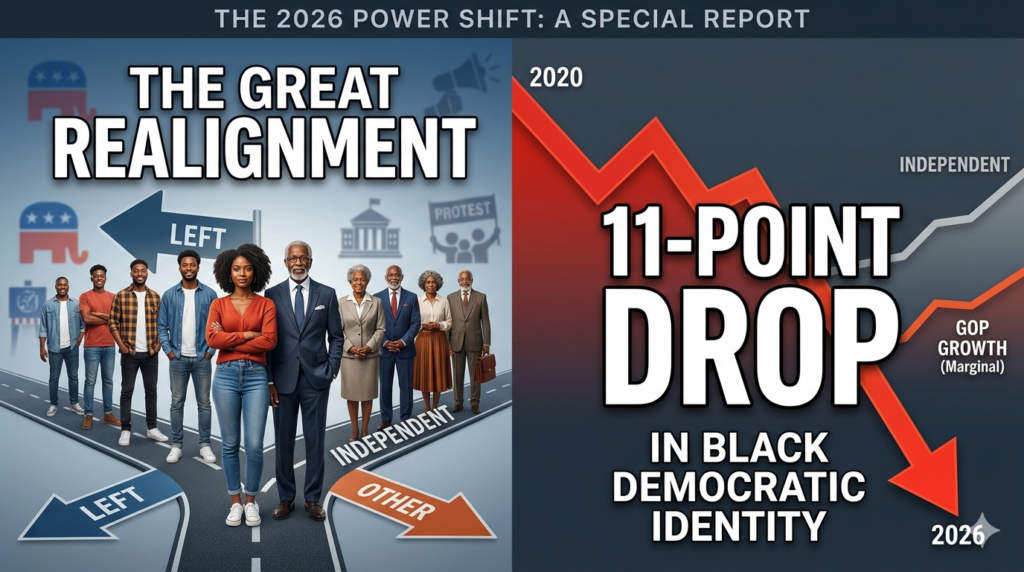
Major Takeaways:
- Generational Disconnect: Gen Z and Millennial Black voters are shifting away from traditional party loyalty, prioritizing current material needs like housing and job security over historical civil rights legacies.
- Economic Anxiety: A rise in Black unemployment and the rollback of DEI programs have fueled a perception that symbolic political rhetoric is failing to provide tangible economic protection.
- Pivot to Autonomy: The “Great Realignment” is characterized by a move toward independent economic ecosystems and “political homelessness,” where voters prioritize practical autonomy over major party affiliation.
Analyzing the Great Realignment and the Rise of Political Independence in Black America
Urban City Podcast Digital News Desk• 7 min read
The catalyst for this realignment is primarily generational. For older Black Americans, the Democratic Party remains inextricably linked to the legislative triumphs of the 1960s. However, for Gen Z and Millennial voters, those victories are often viewed as historical milestones rather than contemporary reasons for loyalty.
Younger voters are looking at their material reality today, specifically the skyrocketing cost of housing, the stability of their jobs in a gig economy, and the safety of their neighborhoods. There is a growing sense that legacy debts to a political party are no longer valid if that party has not delivered a tangible return on the vote within the current decade.
Polling indicates that while these younger voters are not necessarily flocking to the Republican Party in a massive wave, they are increasingly identifying as Independent or Unaffiliated. This “political homelessness” has forced both major parties to change how they communicate with Black communities, moving away from symbolic gestures toward gritty, policy-heavy pitches.
Economic Pressures and Labor Market Shifts
The realignment is also being driven by a deteriorating economic outlook. In the first quarter of 2026, the Black unemployment rate rose significantly, with some urban segments reaching nearly 8 percent. This surge has been exacerbated by the rapid integration of Generative AI in service sector jobs industries that disproportionately employ Black workers.
Simultaneously, the widespread rollback of Diversity, Equity, and Inclusion (DEI) programs has created a vacuum of opportunity in corporate America. While some Black voters blame specific legal challenges for these rollbacks, others are expressing frustration with what they perceive as a lack of effective defense from established political leadership. There is a growing sentiment that the existing political framework is more interested in the rhetoric of equity than the mechanics of economic protection. When people cannot pay their rent, they become less interested in party platform promises and more focused on immediate survival.
The Rise of Social Conservatism and GOP Outreach
While the Democratic decline is the headline, marginal shifts toward the Republican Party are a critical part of the 2026 story. The GOP has successfully tapped into a socially conservative undercurrent within the Black community, particularly among men and faith-based populations. Issues such as school choice, small business entrepreneurship, and traditional family values have become effective bridge-building topics.
The message focused on individual agency and “pulling back the curtain” on government dependency has resonated with a segment of the population that feels traditional liberal platforms have become too socially progressive for their values. However, this inroad remains fragile. Other GOP-led actions, such as aggressive redistricting efforts, are still seen by many as a direct attempt to dilute Black voting power, creating a complex “love-hate” relationship with the conservative platform.
Legal Volatility: The Fallout of Louisiana v. Callais
The 2026 legal landscape has added a layer of extreme volatility to this realignment. A significant Supreme Court decision in Louisiana v. Callais effectively halted the creation of certain majority-minority districts that were previously required under a broader interpretation of the Voting Rights Act.
This has led to a two-pronged reaction in the streets:
-
- Electoral Withdrawal: A segment of the population sees this as proof that the political system is rigged beyond repair, leading to a total drop-off in registration.
- Hyper-Mobilization: Conversely, community organizations have used the ruling as a rallying cry, arguing that if the courts will not protect the vote, the community must mobilize with even greater intensity at the local and municipal level.
While such “states of emergency” regarding voting rights have traditionally benefited Democrats, in 2026, the anger is being directed at the entire political apparatus for failing to secure long-term protections.
From Politics to Practical Autonomy
In response to the perceived failures of mainstream politics, a culture of independence is trending across the country. This is best exemplified by the explosion of independent economic festivals and platforms like Black on the Block. These events prioritize Black-owned business ecosystems and circular economics over political party affiliation.
This movement suggests that the Great Realignment is not just about shifting between parties; it is about a shift from “Political” to “Practical.” There is a growing belief that economic autonomy the ability to build wealth and infrastructure outside of government assistance is a more reliable path to progress than traditional electoral participation.
As the nation moves toward the 2026 midterms, the political world must realize that the Black Vote is no longer a guaranteed asset for any party. The 11-point drop in Democratic identification signals the end of an era of predictable, “wholesale” politics.
Candidates in 2026 are finding that they can no longer rely on endorsements from traditional civil rights organizations or celebrity appearances to win over the community. Instead, they are being met with a more cynical, more informed, and more demanding electorate. The 2026 Power Shift is not just a change in how Black Americans vote; it is a fundamental change in how they view their power in a rapidly shifting American landscape.