7 min read
The Six Triple Eight had a job the Army called impossible, and they finished it in half the time allowed.
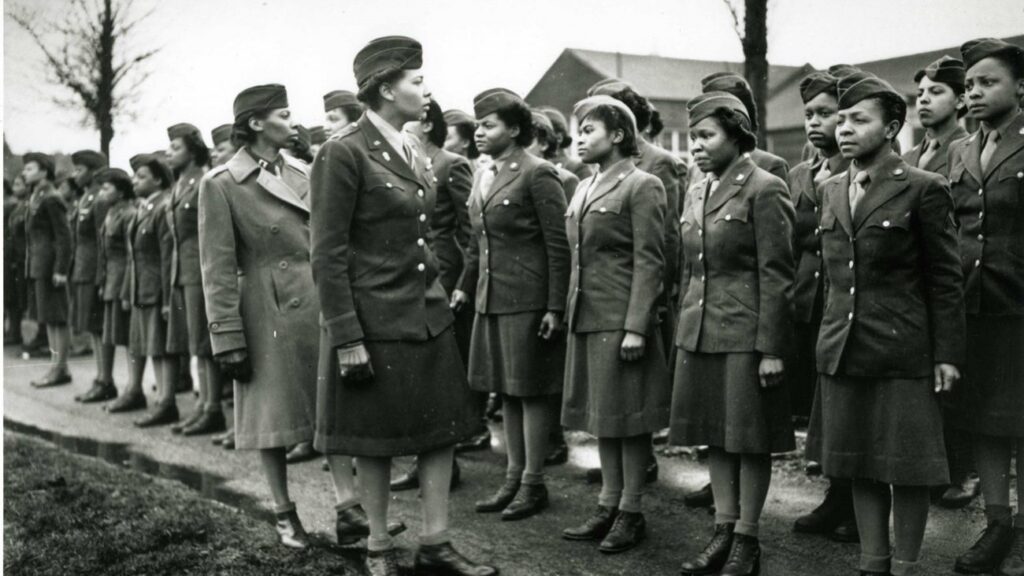
The unit was the 6888th Central Postal Directory Battalion of the Womens Army Corps.
Its 855 women were mostly Black, with members of Caribbean and Mexican descent as well.
They remain the only unit of women of color sent overseas by the Army in World War II.
Their weapon was not a rifle. Their weapon was a system for finding soldiers in a moving war.
Major Takeaways
- The Six Triple Eight cleared about 17 million pieces of mail in Birmingham in three months.
- Each shift handled about 65,000 pieces of mail, working around the clock seven days a week.
- Major Charity Adams was the first Black woman officer in the Womens Army Corps.
- Congress awarded the unit its Gold Medal in 2022, and the ceremony finally came in 2025.
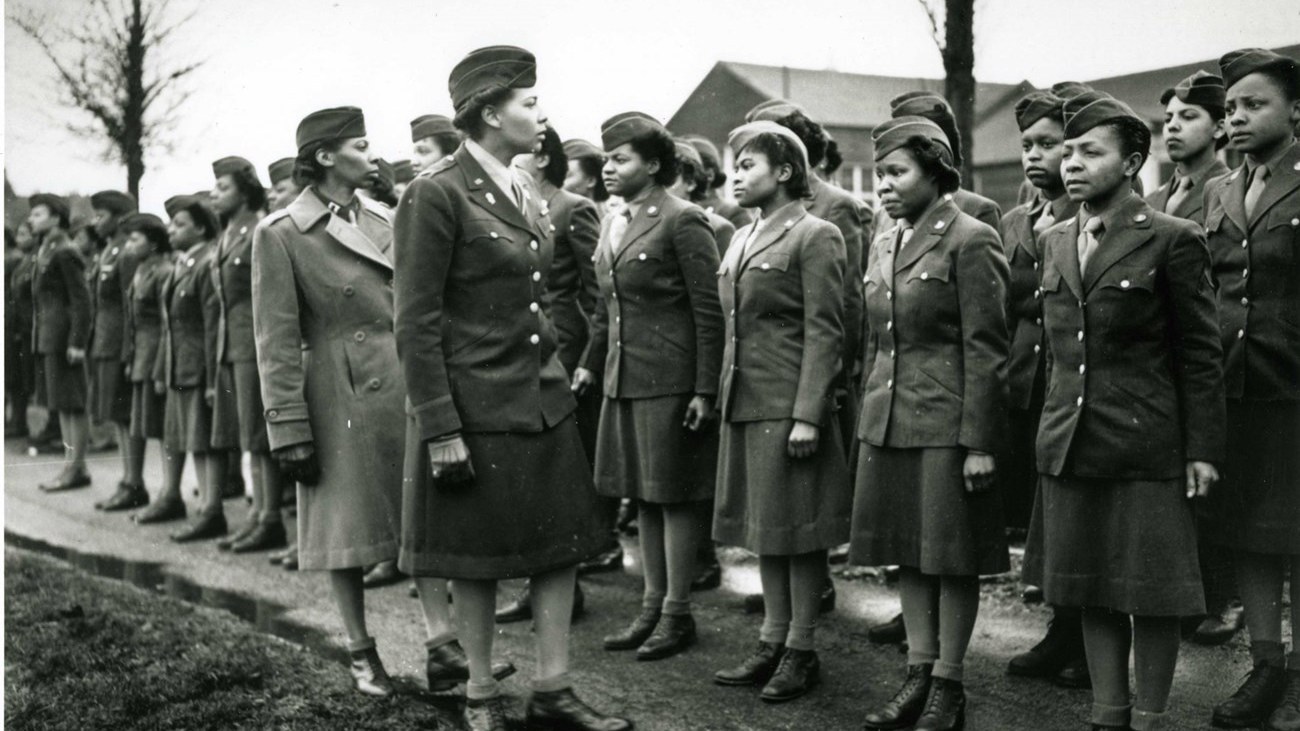
Photo: National Archives
A Door Had to Be Pushed Open
Black women wanted to serve overseas, and the Army kept the door nearly closed.
First Lady Eleanor Roosevelt and educator Mary McLeod Bethune pushed for Black women in the Womens Army Corps.
Black organizations across the country demanded the same chance given to white women.
Our earlier feature tells how Mary McLeod Bethune built a college and a movement from that same resolve.
Pressure worked. In late 1944 the War Department created the 6888th for overseas duty.
About 6,500 Black women served in the corps during the war, out of more than 140,000 women in all.
The women trained at Fort Oglethorpe in Georgia, in five companies built to run on their own.
They learned drills, gas mask work, ship safety, and the postal trade that waited in Europe.


Charity Adams Took Command of the Six Triple Eight
Their commander was Major Charity Adams, a former teacher from South Carolina.
Adams was valedictorian at Booker T. Washington High School and a graduate of Wilberforce College in Ohio.
On August 29, 1942 she became the first Black woman commissioned as an officer in the corps.
She was only 26 years old when she took command of the battalion in Europe.
Adams and Captain Abbie Campbell reached London on January 28, 1945 to prepare the way.
Her official orders lagged so long that on March 2 she issued her own and assumed command.
She finished the war as a lieutenant colonel, the highest ranking Black woman in the Army then.
No Mail, Low Morale
The battalion sailed on February 3, 1945 aboard the liner Ile de France.
The ship dodged German submarines on the crossing and reached Scotland nine days later.
A train carried the women south to Birmingham, England, and to warehouses stuffed with mail.
About 7 million Americans served in Europe then, and their letters had piled up for months.
Some pieces had waited as long as three years without reaching the soldier named on them.
Hangars stood full from floor to ceiling, much of it Christmas mail returned during hard fighting.
The rooms were cold and poorly lit, with windows covered against night air raids.
Rats got into packages of cake and cookies that had spoiled while the mail sat waiting.
Army leaders gave the women six months to clear the mountain. The women took three.
Their motto said why the work mattered so much to them. No mail, low morale.
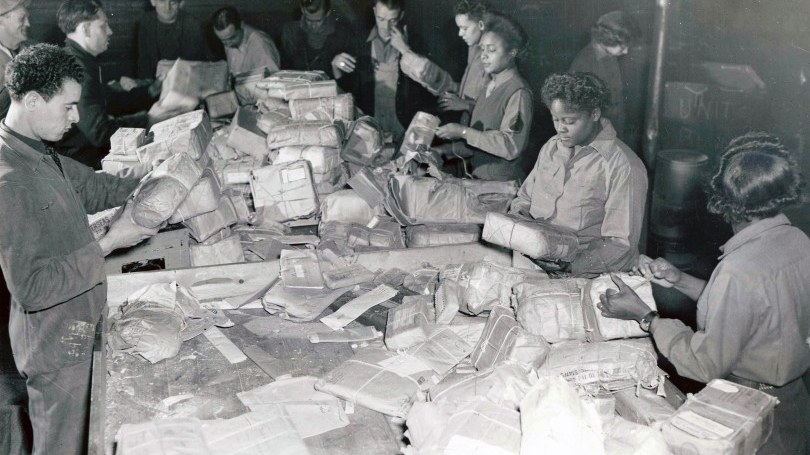
Photo: U.S. Army and National Archives
The System They Built Themselves
The battalion split into three shifts and worked around the clock, seven days a week.
Each shift moved about 65,000 pieces of mail toward the right soldier.
The women built an index of more than 7 million cards to track names and units.
Each card carried a name, a unit, and a serial number for a single service member.
That detail mattered, because about 7,500 men in Europe shared the name Robert Smith.
Clerks chased mail marked only with a nickname or a partial and fading address.
Units moved toward Germany every day, so sorted mail often came back and began again.
Each piece was worked for up to 30 days before it was returned as undeliverable.
The hardest duty was mail for a soldier who had died before it could reach him.
The women handled those returns with care, knowing a family waited on the other end.
Segregation Followed Them Overseas
The women served a nation that still sorted its own soldiers by race.
Housing and eating sites in England were segregated by both race and gender.
A local club welcomed Black male soldiers but turned the Black women away.
Offered separate rooms of their own, Adams led a boycott and the women stayed away.
Instead the battalion ran its own food hall, hair salon, and refreshment bar.
Some male soldiers spread slander about why Black women had been sent to Europe.
The women answered with work, and soldiers who got their mail thanked them in the streets.
Their basketball players lost a place on an Army star team once officials saw their race.
The battalion team responded by winning the theater championship that same year.
In July 1945 three members died in a jeep crash in France.
The War Department sent no money for their funerals, so the unit raised its own.
The three women rest at Normandy American Cemetery, buried by the sisters who served beside them.
Rouen, Paris, and a Quiet Trip Home
Birmingham was cleared in May 1945, and the Army sent the battalion to France.
At Rouen they faced another backlog, with some letters three years old.
French civilians and German prisoners of war joined the sorting lines beside them.
The women marched in the Rouen parade honoring Joan of Arc on May 27, 1945.
By October the Rouen mail was cleared, and the battalion moved on to Paris.
There they sorted packages at the 17th Base Post Office as the war wound down.
About 300 women went home as discharges began, and 200 more followed in January 1946.
In February 1946 the last of the unit returned to the United States.
No band played. No ceremony waited. The battalion was disbanded at Fort Dix in New Jersey.
Members held three medals for their service, and little public thanks beyond them.
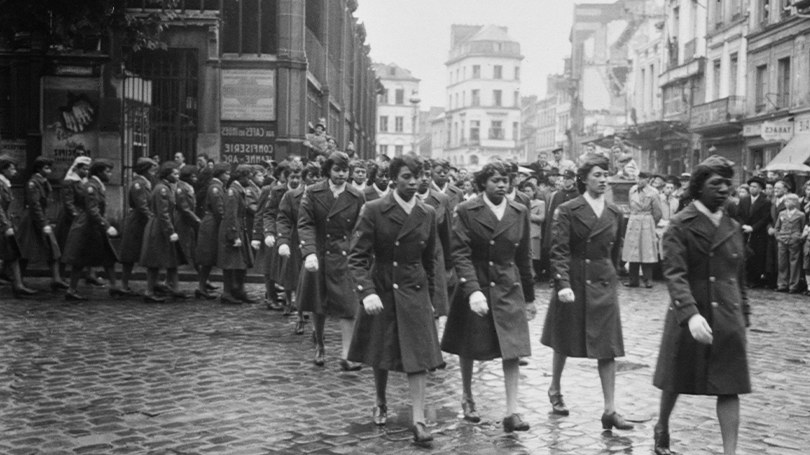
Photo: National Archives
The Honor Arrived Decades Later
Recognition came slowly, and most of it came after the women had grown old.
Birmingham honored returning members in 1981, and Adams published her memoir in 1989.
A monument rose at Fort Leavenworth in Kansas on November 30, 2018.
The Army awarded the unit a Meritorious Unit Commendation in 2019.
On March 14, 2022 President Biden signed the law awarding the Congressional Gold Medal.
The House had passed that measure by a vote of 422 to 0.
Only six members were still living on the day the law was signed.
The medal ceremony finally filled Emancipation Hall at the Capitol on April 29, 2025.
About 300 descendants gathered as the children of Charity Adams Earley accepted the medal.
The medal then went to the Smithsonian Institution, where the public can see it.
In 2023 the Army renamed Fort Lee in Virginia as Fort Gregg Adams in her honor.
Why the Six Triple Eight Still Matters
Adams warned in her memoir that young Black women would find scant record of women like her.
For decades she was right, and schoolbooks passed over the battalion in silence.
That silence is ending, one ceremony, one classroom, and one family story at a time.
The story belongs beside our feature on Shirley Chisholm and the doors she forced open a generation later.
These women proved their skill in a place that expected them to fail at the task.
They lifted the morale of an entire army while fighting for respect inside that army.
That double fight is the heart of Black service in every American war.
Read more Black history and news in our own voice at Urban City Podcast.
The Six Triple Eight delivered the mail. History is finally delivering their honor.