7 min read
Major Takeaways
- Paul Revere Williams became the first licensed Black architect west of the Mississippi River in 1921.
- He designed more than 3000 buildings, from star mansions to public housing and Black churches.
- Racist clients and land covenants tried to box him out, and he answered with pure excellence.
- Los Angeles is honoring him again this season with a major exhibition series across three institutions.
Paul Revere Williams drew the Los Angeles that the world thinks it knows.
His arches soar over the runways at the city airport. His script sign glows above a famous pink hotel.
He designed the mansions of movie stars and the headquarters of Black business. He did it all in an era that tried to deny him a seat at his own drafting table.
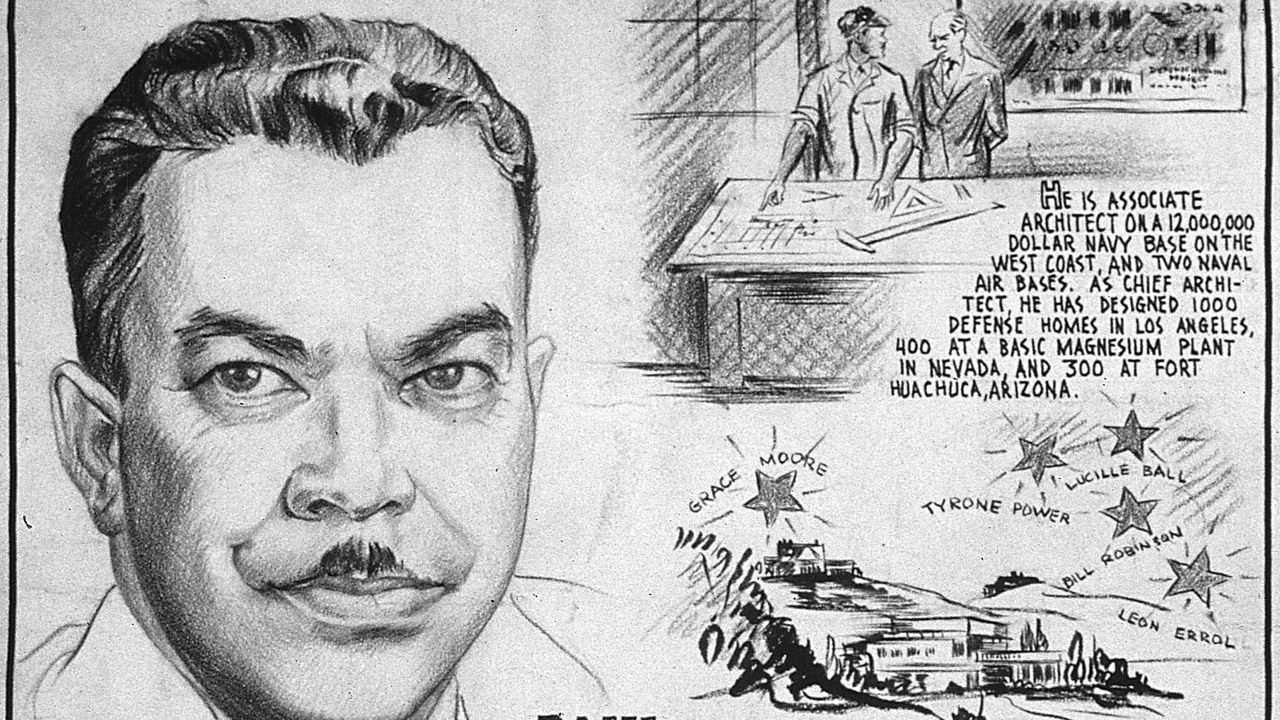
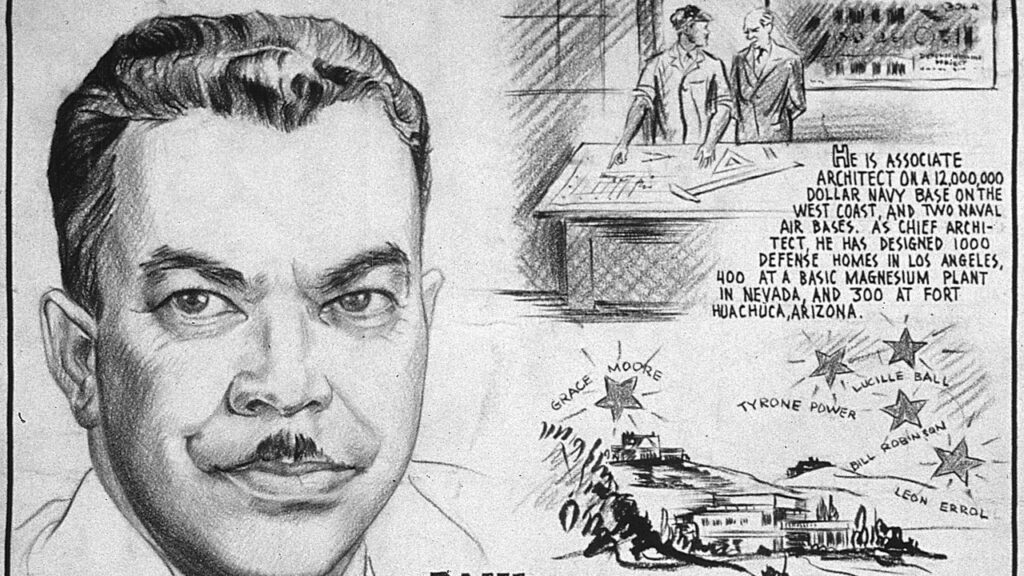
Drawing by Charles Alston for the Office of War Information in 1943. National Archives, public domain.
A Boy With No Parents and One Big Dream
Williams was born on February 18, 1894, in downtown Los Angeles. His parents had come west from Memphis with dreams of a fairer life.
Both parents died of consumption within two years of each other. Paul was an orphan by the age of four.
A foster mother who was a family friend raised him. She pushed his schooling and told him he could achieve anything he wanted.
He was the only Black student at his elementary school. The loneliness could have crushed him, and it did not.
At Polytechnic High School he fell in love with architecture. Counselors warned him away from the field because of his race.
White clients would never hire a Black architect, they told him. Williams kept drawing anyway.
He studied at the Los Angeles School of Art and Design. He trained in a Beaux Arts atelier and studied architectural engineering at the University of Southern California.
In 1920 he won a seat on the first Los Angeles City Planning Commission. A young Black man was helping plan the city that doubted him.
In 1921 he earned his California license. He was the first licensed Black architect west of the Mississippi River.
In 1923 he broke another line. He became the first Black member of the American Institute of Architects.
Paul Revere Williams Learned to Draw Upside Down
Success did not shield him from insult. Some white clients refused to shake his hand.
Some felt uneasy sitting beside a Black man at a desk. So Williams taught himself to draw upside down.
He stood across the table and sketched plans toward his clients. The trick dazzled them before doubt could speak.
He later called it an artistic sleight of hand. It was about making a first impression so strong that people thought twice about judging his skin.
In a 1937 essay he wrote the truth plainly. “I came to realize that I was being condemned, not by lack of ability, but by my color.”
“I wanted to vindicate every ability I had,” he wrote. “I wanted to prove that I, as an individual, deserved a place in the world.”
Restrictive covenants barred Black buyers from many fine neighborhoods. Williams designed dream homes on streets where he himself could not live.
He answered exclusion with range. He mastered Tudor Revival, Regency, French Chateau, Mediterranean, and sleek Moderne design, often in the same season.

Architect to the Stars, Builder for the People
Hollywood came calling and kept calling. Williams designed homes for Frank Sinatra, Barbara Stanwyck, and Lucille Ball with Desi Arnaz.
Like filmmaker Oscar Micheaux, he built Black excellence inside an industry that tried to lock the door.
He designed the Saks Fifth Avenue store in Beverly Hills. He shaped the Palm Springs Tennis Club for desert leisure.
His Music Corporation of America building won an Award of Merit from his institute in 1939. The honor came from peers who once doubted his place.
Through the 1940s he remade the Beverly Hills Hotel. His additions gave the Pink Palace its Crescent Wing and its famous flowing script sign.
Then came the sting that said everything about the era. After redesigning that hotel, Williams was denied entry to its pool.
The same hands built for working families with equal care. With fellow Black architect Hilyard Robinson, he helped design Langston Terrace in Washington.
Langston Terrace stood among the first federally funded public housing projects in the nation. Dignity was built into every courtyard and doorway.
In Los Angeles he joined Richard Neutra on Pueblo del Rio. The garden style housing gave factory workers and veterans light, air, and green space.
In 1962 he designed a research hospital for sick children in Memphis. He charged founder Danny Thomas nothing for the work.
A Saucer Over the Runways
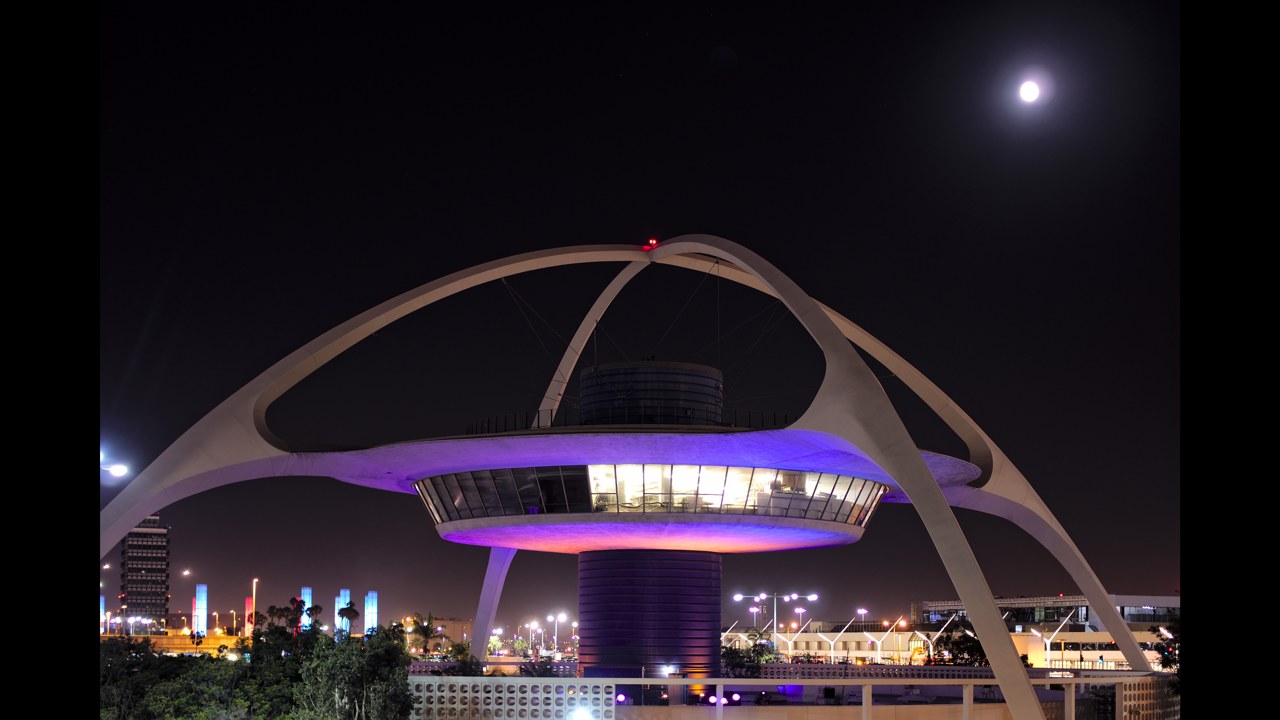
Photo by Junkyardsparkle via Wikimedia Commons, dedicated to the public domain.
By 1961 Williams was helping imagine the space age. He joined William Pereira, Charles Luckman, and Welton Becket on the team behind the Theme Building.
The building floats like a saucer on four great arches. It became the postcard of the jet age and the symbol of the airport.
Travelers who know nothing of its makers know its silhouette. A Black architect from South Los Angeles helped give the world that picture.
The House That Black Business Built
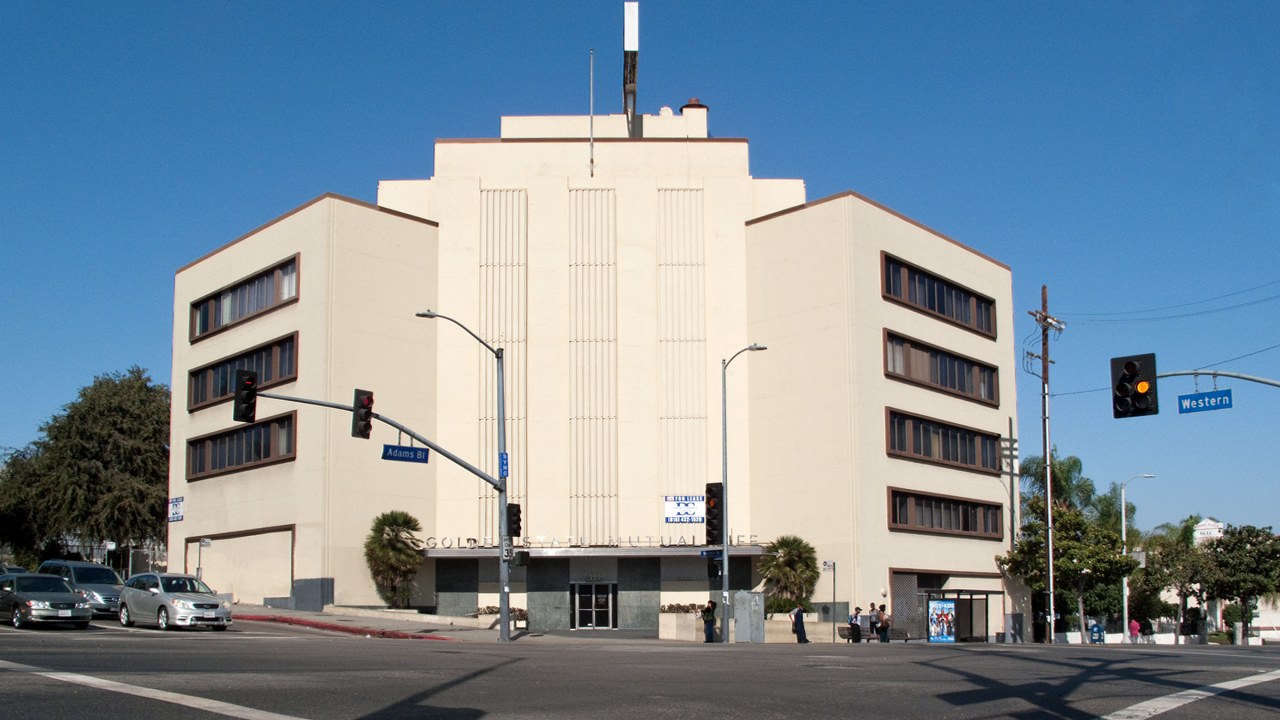
Photo by Downtowngal via Wikimedia Commons.
Williams never forgot his own people while stars kept him busy. His proudest commissions served Black Los Angeles directly.
Golden State Mutual Life Insurance was founded in 1925 by Black businessmen. White insurers had shut Black families out, so the company served its own.
It grew into the largest Black owned insurance company west of the Mississippi. The firm belonged to the same tradition of Black enterprise that Madam C. J. Walker built a generation earlier.
In 1949 the company opened the headquarters Williams designed for it. The building rose at Adams Boulevard and Western Avenue in West Adams.
Its grand lobby carried two murals by Charles Alston and Hale Woodruff. The art traced Black life in California from exploration through settlement and growth.
The building later became city Historic Cultural Monument number 1000. A memorial plaza beside it now honors Williams with a bronze relief.
He gave the community its anchors too. His works ranged from the 28th Street YMCA in 1926 to the First African Methodist Episcopal Church sanctuary in 1968.
Honor Came Late, and It Is Still Coming
In 1957 Williams became the first Black architect raised to Fellow in his institute. The honor marked a lifetime of work the field could no longer ignore.
He retired in 1973 after more than fifty years of practice. He died on January 23, 1980, at the age of 85, and rests at Inglewood Park Cemetery.
In 2017 his institute gave him its Gold Medal. He was the first Black architect ever to receive the honor, and it arrived 37 years after his death.
In 2020 the Getty Research Institute and the University of Southern California jointly acquired his archive. Tens of thousands of drawings and plans found a permanent home.
This season the honor continues in his own city. The Getty, the Los Angeles County Museum of Art, and the USC Fisher Museum of Art are showing his work in a shared exhibition series running into the summer of 2027.
The work is not finished. One survey of his institute counted Black members at less than two percent of the total.
Every young Black designer who walks into a studio walks through a door he forced open. His buildings still stand across Los Angeles as proof of what talent does when it refuses to shrink.
Read more Black in the Day features at Urban City Podcast, and share this story with someone who loves this city.