10 min read
By Felicia Kelly-Brookins | Urban City Podcast, Cultural Autopsy
Major Takeaways
For many Black families in the 1970s, Christmas was measured in traditions and togetherness, not expensive gifts.
The kitchen was the heart of the holiday, where every recipe carried a family story from one generation to the next.
Nostalgia can comfort and connect us, but the holidays also call for compassion for the people who grieve or struggle.
There was something about Christmas in the early 1970s that no amount of money, modern technology or beautifully decorated Christmas trees can ever quite reproduce.
Maybe it was the smell of Grandma’s homemade coconut cake sitting on the kitchen counter.
Maybe it was the sound of James Brown singing “Santa Claus Go Straight to the Ghetto” while somebody’s mother hollered from the kitchen for the children to stop running in and out of the house.
Or maybe it was that big bowl of ambrosia salad, filled with oranges, pineapple, coconut and whatever else Grandma decided belonged in it that year.
Whatever it was, Christmas had a different kind of flavor back then.
And for many Black American families, especially those of us raised in the South, the memories of Christmas were not necessarily wrapped in expensive paper or tied with fancy ribbons.
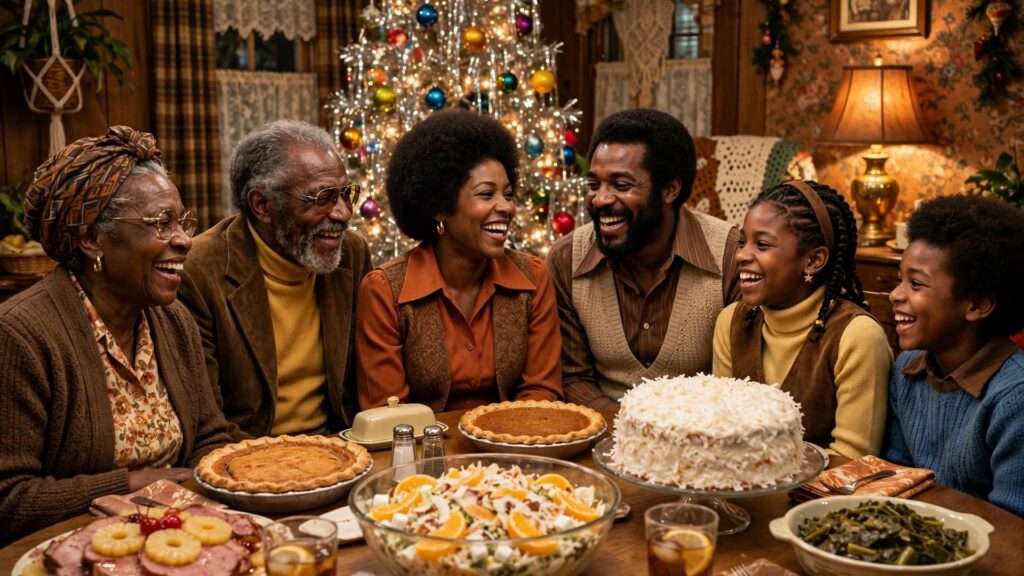
They were wrapped in family traditions, seasoned with love and served on somebody’s best dishes.
It Was a Family Tradition
If you grew up in the 1970s, you probably remember the Sears, Roebuck and Co. Christmas Wish Book. Oh, that catalog was something! We waited all year to get that.
Long before children created online wish lists, we sat on the floor turning those pages, circling dolls, bicycles, toy trucks, Easy-Bake Ovens and everything else we thought an imaginary figure we call Santa Claus was going to squeeze down a chimney that most of our houses didn’t even have.
Never mind that Mama and Daddy were working overtime, stretching dollars and trying to make Christmas happen. As children, we only knew that Santa Claus was coming.
And speaking of Christmas trees, does anybody remember those artificial trees with the individual limbs that had to be pushed into little holes in a center pole?
Some were green. Others were silver and shiny, with branches that looked as though they were made of tinsel.
Putting that tree together required patience, determination and at least one grown up who knew which branch went where.
And once it was standing, decorated with ornaments, lights and perhaps a little too much tinsel, we thought it was the most beautiful Christmas tree in the world.
Underneath it might have been only a handful of presents, but in our little eyes, it looked like a department store.
The Soundtrack of Christmas
Christmas in our homes also had its own soundtrack. The music was not simply background noise. It was part of the celebration.
James Brown’s “Santa Claus Go Straight to the Ghetto” brought a soulful reminder that Christmas belonged to children in every neighborhood, including those whose families didn’t have much money to spare.
It still makes me get up and dance as the memories flood through my mind of happier times with all my loved ones.
And when The Emotions sang “What Do the Lonely Do at Christmas,” it was the official notification that Christmas time was indeed here.
That song had a beautiful harmony that even to this day goes deeper than holiday cheer. It is a song about the importance of the gift of love, giving and sharing especially during the holidays.
That song acknowledged a truth we sometimes overlooked during the holiday season: not everybody was celebrating with a full house or a happy heart.
There were also the familiar sounds of church choirs, gospel Christmas selections and holiday records spinning on the stereo.
Music floated from living rooms into kitchens, from front porches into neighborhoods. Somebody might be singing along while stirring a pot.
Somebody else might be dancing between the dining room and the kitchen with their favorite aunt or uncle.
The music gave Christmas its rhythm. And decades later, hearing one of those familiar songs can still take us right back to a particular house, a certain kitchen or a loved one who is no longer with us.
That’s the power of music. It remembers what time sometimes tries to erase.

The Kitchen Was Where the Magic Happened
But if you ask me, some of the greatest Christmas memories were made in the kitchen. Not the living room. Not around the Christmas tree. The kitchen.
That was where the real magic happened.
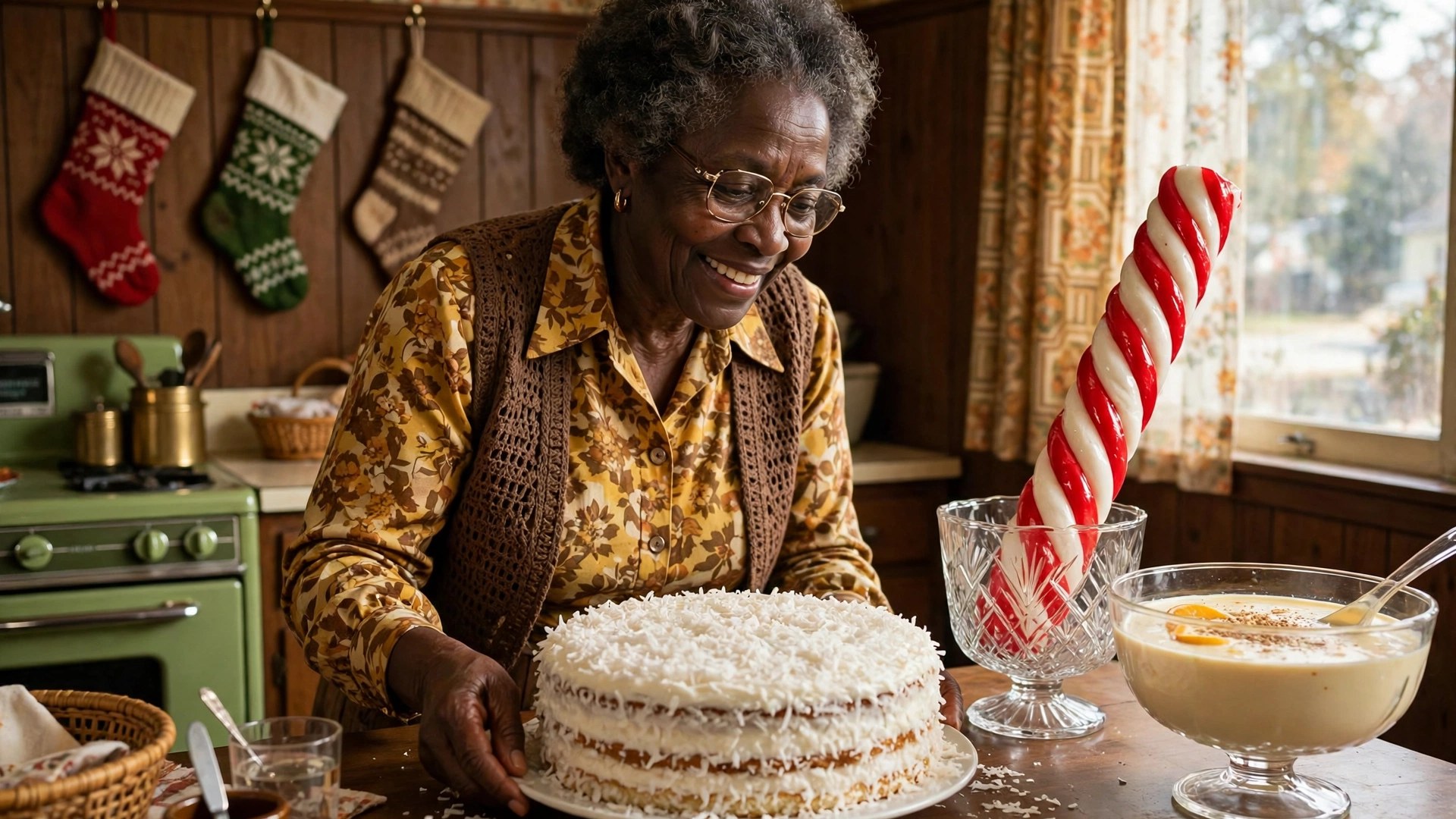
There was homemade coconut cake, with layers of fluffy frosting and coconut so thick that you could hardly see the cake underneath.
There was ambrosia salad, that colorful mixture of fruit and coconut that seemed to make an appearance at every holiday gathering.
Some families added marshmallows. Others preferred just the fruit mixture. And every grandmother was convinced her version was the best and right one.
There were sweet potato pies, pound cakes, dressing, baked ham, macaroni and cheese, collard greens and enough food to feed relatives who hadn’t even announced they were coming.
And let’s not forget the eggnog. It was never my favorite, but I remember many an adult with a glass full, laughing around that crystal punch bowl with that little glass in their hands, giggling a little bit more than usual, it seemed.
Stockings, Peppermint Sticks and Cousins
Then there were the Christmas stockings. They were not always overflowing with expensive gifts.
Sometimes a stocking held a small toy, an orange, an apple, a few pieces of peppermint candy and maybe some nuts.
And who remembers that enormous peppermint stick? The one that seemed big enough to last until Easter, but somehow stayed in the candy dish or on the kitchen table all year.
We would break off a piece, wrap the rest back up and return to it whenever we wanted something sweet.
Those little things mattered. And the older I get, the more I realize that the food was never just food.
Every recipe carried a story. Every dish represented somebody’s time, labor and love.
And every grandmother who stood in that kitchen was doing more than preparing Christmas dinner. She was preserving a piece of our family history.
Christmas also meant cousins. Lots of cousins. Some you saw every weekend. Others you only saw during holidays and family gatherings.
The house would fill with laughter, conversations, children running through the rooms, walking up and down the neighborhood dirt road or street in groups, laughing with each other or making jokes about each other.
You might get fussed at by your grandmother or mother for being too loud, told to go outside or warned not to touch anything on the dining room table until they were finished cooking.
And there was always at least one aunt who wanted to know how you were doing in school or if you had a little boyfriend or girlfriend.

Christmas Eve and Christmas Morning
Then came Christmas Eve. The excitement was almost unbearable.
We were told to go to bed early because Santa Claus wouldn’t come while we were awake.
And somehow, even though we could barely sleep, we managed to wake up earlier than we ever did on a school morning.
Before sunrise, little feet were moving through hallways, eyes searching beneath the Christmas tree. The wrapping paper flew. The laughter started.
What we didn’t understand then was that while we were sleeping, somebody had been working.
Somebody had wrapped the presents, put together the bikes, set up the gifts and ate the cookies you left out for Santa Claus.
Christmas morning was the most special morning of the year to me as a child.
It took me growing older to understand that Santa Claus may have been imaginary, but the sacrifices behind those presents were very real.
What Those Memories Teach Us
Today, I think about those Christmases a little differently.
As someone who believes deeply in the relationship between storytelling, family experiences and mental wellness, I understand that nostalgia can offer comfort, connection and a sense of belonging.
The familiar smell of coconut cake, the sound of an old Christmas record or the taste of ambrosia salad can bring back memories of people, places and moments when we felt loved.
For some, gathering around the holiday table provides emotional nourishment that extends far beyond the food.
It offers an opportunity to reconnect, laugh, remember and simply be in the presence of people who know our stories.
But we must also acknowledge another truth. For some people, Christmas is difficult.
The holidays can bring loneliness, grief, financial pressure, family disagreements or painful reminders of loved ones who are no longer here.
And sometimes, the very traditions that once brought us joy can bring tears because the person who created them is missing from the table.
That is why I believe we should approach the holidays with more compassion and less expectation.
Not everybody has a happy Christmas story. Not every family gathering is peaceful. And not every holiday memory is one some people want to revisit.
Yet even in complicated family histories, there may be one beautiful memory worth holding on to. Sometimes it is the food.
A grandmother’s cake. An aunt’s sweet potato pie. A mother’s dressing. The adults dancing.
The Recipe Is Only Part of the Inheritance
As we celebrate Christmas in 2026, I wonder how many of those old family recipes are still being prepared.
How many grandchildren know how to make Grandma’s coconut cake? Who still prepares the ambrosia salad?
And how many of us have taken the time to ask our elders about the recipes, traditions and Christmas stories that shaped our families?
In a world where so much of our food can be purchased already prepared and our holiday celebrations can be planned with the click of a button, perhaps we should consider what we might be losing.
Because the recipe is only part of the inheritance. The real treasure is the story behind it.
Who taught Grandma to make that cake? Why was that particular dish always served at Christmas? Who was the family member who always asked for seconds? And whose chair sits empty today?
These are the stories that deserve to be remembered and passed down.
This Christmas, perhaps we should spend a little less time worrying about creating the perfect holiday and a little more time preserving the imperfect, beautiful traditions that made our childhood Christmases unforgettable.
Pull out an old recipe. Play a James Brown Christmas song. Call a cousin. Ask an elder to tell you what Christmas was like when they were young.
And if you still have the privilege of sitting in your grandmother’s kitchen, don’t just ask her what’s cooking. Ask her to tell you a story.
Because one day, the recipe may be all you have left of that moment.
And when you taste it again, you’ll understand that what you were really hungry for was not just the coconut cake or the ambrosia salad. It was the love that came with it.
And maybe that is what made Christmas so special back then. We didn’t always have everything we wanted beneath the tree.
But sometimes, without even realizing it, we had everything we needed gathered around the table.
Merry Christmas. May your memories be sweet, your traditions live on, and your table always have room for one more.
Share this story with family, then enter the Urban City Podcast Holiday Takeover for your shot at the grand prize this Christmas season.

About the Author
Felicia Kelly-Brookins is an award winning author, screenwriter, playwright and mental health advocate. She is the founder of S.A.F.E. S.P.A.C.E. Youth and Teen TheaterTherapy Foundation and TheBrownie Collective. Through her storytelling platform, Cultural Autopsy, on Urban City Podcast, she examines the stories we inherit, the lessons we carry and the truths we’re still learning to tell.