
MAJOR TAKEAWAYS
- Social media has turned love into a performance instead of a private connection
- Unrealistic expectations are being shaped by comparison, not real-life experience
- Young people are learning relationship standards from what’s visible not what’s valuable
LOVE, LIKES & LIES: PART FOUR
How social media Is Rewriting Dating Expectations for a Generation Still Learning What Love
Means
Op-Editorial By Felicia Kelly-Brookins• 6 min read
There was a time when love was something you felt, quietly, deeply, and often privately.
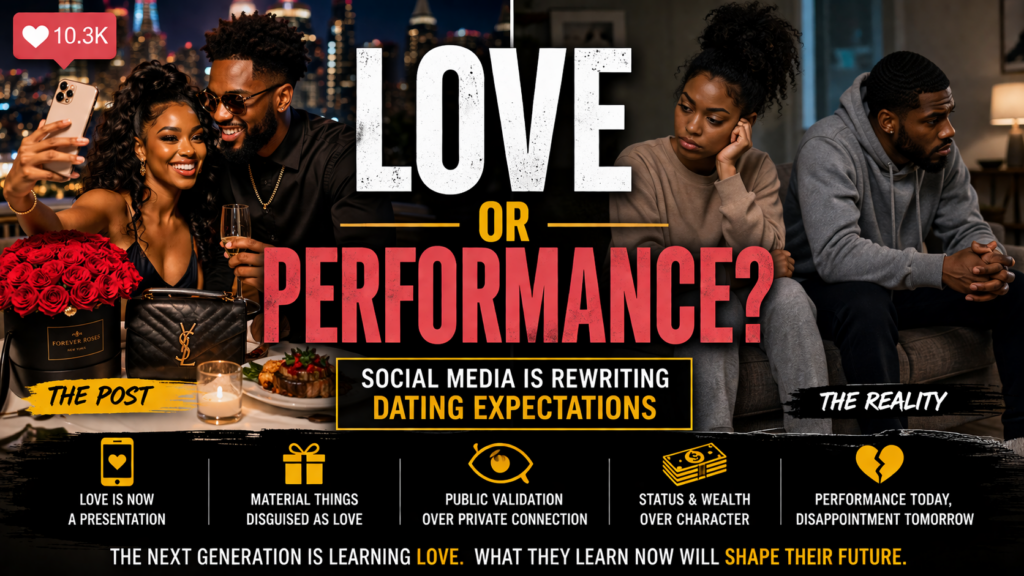
Now, it is something you prove. Scroll through any social feed and the message is clear: love
is no longer just an experience, it’s a presentation. It’s curated in real time, measured in
reactions, and validated by visibility. The dinner dates are no longer just shared, they’re
staged. Gifts aren’t simply given, they’re documented. And the relationship itself becomes
social media content before it ever has the chance to become connection.
For a generation raised on digital affirmation, love is being redefined in ways that are subtle,
but significant. What used to be built through conversation is now inferred through captions.
What once required emotional presence is now replaced by public performance. And in that
shift, something sacred is being repackaged as something sellable.
The danger isn’t just in what is being shown, it’s in what is being believed.
Because when love begins to look like a lifestyle brand, it stops being about alignment and
starts becoming about acquisition. Who has more, gives more and looks like more. And for
teenagers and young adults still forming their understanding of relationships, the line
between what is real and what is rehearsed is becoming harder to see.
What they are witnessing is not just influencing how they date. It is shaping what they expect
love to cost and what they believe it is worth.
There is also a noticeable shift in what is being prioritized.
Social media has elevated:
• What someone has over who they are
• How someone looks over how they live
• What someone gives over what they stand for
Lavish gifts become proof of love. Public displays become validation of commitment.
Financial status becomes a prerequisite for worthiness. But material indicators were never
meant to carry the weight of emotional or spiritual compatibility.
Because when love is measured by what can be posted, it will always require an audience to
feel real. And relationships that depend on performance rarely survive in private.
The issue is not that young people have standards. The issue is where those standards are
coming from. When expectations are shaped by comparison, they become unrealistic.
When they are shaped by insecurity, they become demanding. When they are shaped by
culture without correction, they become unstable.
Young people are entering relationships carrying expectations they did not build, but feel
entitled to enforce. And without grounding, those expectations often lead to disappointment,
conflict, and emotional instability. Because what is trending is not always what is true.
This is where accountability becomes necessary. Women, mothers, mentors, influencers,
and visible voices, are not just participants in culture. They are architects of it.
And the question must be asked:
What are we modeling?
What are we promoting?
What are we normalizing?
Because whether intentional or not, younger women are watching. They are studying how
love is discussed. How relationships are handled. How worth is defined. And they will follow
what they see, even if it leads them away from what is right.
If the message being modeled prioritizes attention over integrity, validation over values, and
visibility over virtue, then we should not be surprised when the next generation adopts the
same blueprint. Guidance is not just what we say. It is what we live.
If social media has become the loudest teacher, then truth must become more intentional.
Because love was never meant to be learned through comparison. It was meant to be
cultivated through character. Developed through patience. Strengthened through purpose.
Teenagers and young adults do not just need better advice. They need better examples.
They need to see relationships that are not performative, but principled. Not perfect, but
purposeful. Not built for display, but built to last. Because the next generation is not just
watching love. They are learning it. And what they learn now will shape not only how they
date, but how they build, break, and believe in love for the rest of their lives.