

3 Major Takeaways
- The economy isn’t as stable as it looks low unemployment masks hiring slowdowns and job losses.
- Stress is the real epidemic driven by AI disruption, layoffs, and lack of control.
- Adaptation is the new job security skills, networks, and awareness are survival tools now.
The Weight of Uncertainty: Stress, Survival, and the Shifting American Workforce
By Felicia Kelly-Brookins• Urban City Podcast 2026 Stress Awareness Month April Edition 7 min read
There are moments in history when the ground beneath us does not collapse all at
once but instead shifts, quietly and steadily, until what once felt certain begins to feel
unfamiliar.
This is one of those moments. Across the nation, the labor market is sending mixed
signals. On paper, stability. In lived experience, uncertainty.
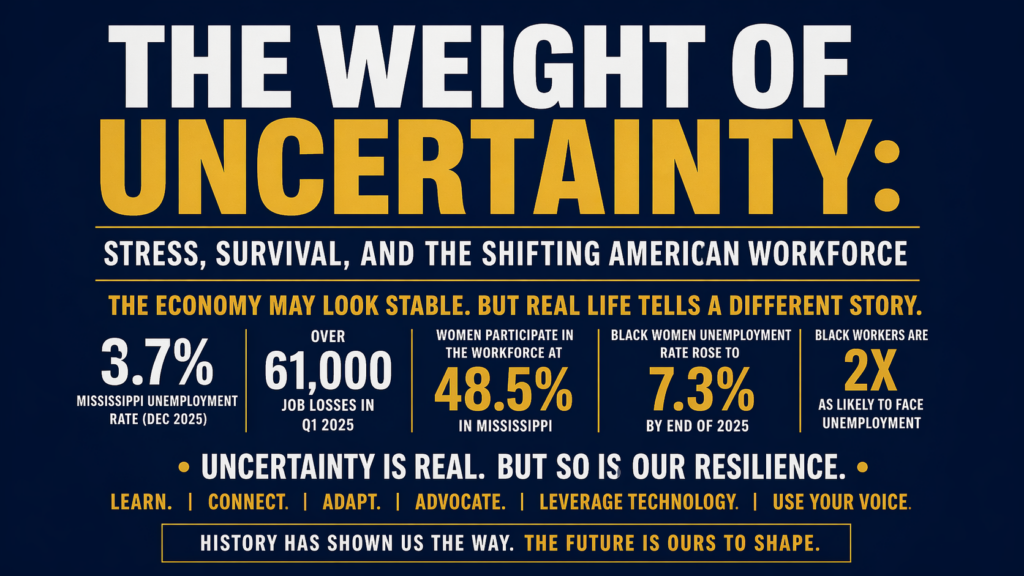
In Mississippi, the unemployment rate stood at approximately 3.7% as of December
2025, a figure that, at first glance, suggests economic strength. ( USAFacts )
Yet economists describe the current landscape as a “no-hire, no-fire” economy a
labor market where movement has slowed, hiring has plateaued, and opportunity feels
increasingly difficult to access. (Mississippi Today)
At the same time, more than 61,000 job losses were recorded in a single quarter of
2025 due to business closures and contractions, a stark reminder that stability on paper
does not always translate to security in practice. (Bureau of Labor Statistics)
And beneath these numbers lies something less visible,but far more personal:
Stress.
The American workforce is being reshaped in real time. Corporate acquisitions are
restructuring entire industries. Layoffs are no longer isolated events but recurring
patterns. And artificial intelligence, once a distant innovation, is now embedded in hiring
practices, productivity systems, and decision-making processes.
For workers, this raises urgent and deeply human questions:
Will my role still exist tomorrow?
Am I prepared for what the future demands?
How do I remain competitive in a system that is evolving faster than I can adjust?
These are not abstract concerns. They are the quiet anxieties carried into homes,
classrooms, and communities every day.
While the broader labor market shows signs of resilience, the data reveals a more
complex reality for women,particularly in Mississippi. Women in the state participate in
the workforce at significantly lower rates than men 48.5% compared to 59.8% a gap
shaped by barriers such as childcare access, wage disparities, and limited economic
mobility. (Mississippi Today)
For Black women, the strain is even more pronounced on a national level. By the end of
2025, unemployment among Black women had risen to approximately 7.3% the
highest rate in four years, signaling a troubling shift in economic stability. (19th News)
Historically, Black workers are twice as likely to face unemployment as their white
counterparts, a disparity that continues to persist across states and economic cycles.
(Economic Policy Institute) These numbers do more than reflect economic conditions,
they reflect lived experiences. Experiences of overqualification and underemployment.
Experiences of being essential, yet expendable. Experiences of navigating systems that
were not designed with equity in mind.
Layered onto economic uncertainty are policy conversations that shape not only access
to opportunity, but access to voice. Legislation such as the SAVE Act has ignited
national debate around voting rights, access, and civic participation. For women,
particularly Black women, who have long stood at the forefront of advocacy,these
discussions carry significant weight.
Because the ability to vote is not separate from the ability to influence:
Employment policy
Economic investment
Education funding
Healthcare access
When access to voice feels uncertain, the stress extends beyond the individual, and into
the collective. And yet, this moment, while modern in its form, is not unfamiliar in its
burden.
Black women, in particular, have navigated generations of economic instability, systemic
exclusion, and shifting labor demands. And still,they have built.
They have led. They have organized. They have sustained families, communities, and
movements.
What history teaches us is not simply survival, but strategy:
The power of community networks
The necessity of adaptability
The importance of protecting one’s voice
These are not just lessons from the past. They are blueprints for the present.
While economic forces may feel beyond individual control, there are grounded ways to
navigate the stress they create.
1. Reclaim What You Can Control
Invest in skill development and lifelong learning. In an AI-driven economy, adaptability is
no longer optional, it is essential.
2. Build Strategic Community
Connection is currency. Professional networks, mentorship, and peer support systems
can open doors that isolation cannot.
3. Create Emotional Outlets
Unprocessed stress becomes sustained stress. Writing, therapy, faith practices, and
creative expression provide necessary release.
4. Stay Informed, Not Overwhelmed
Awareness is power,but overexposure can heighten anxiety. Engage intentionally with
information.
5. Use Technology as Leverage
Artificial intelligence does not have to replace you,it can enhance you. Learn it. Use it.
Position yourself alongside it.
6. Protect and Exercise Your Voice
Stay civically engaged. Understand the policies that impact your life. Advocacy is not
optional,it is necessary.
There is no denying that we are in a period of transition. But history reminds us that
transition is not only a space of discomfort,it is a space of transformation.
And for those carrying the weight of uncertainty, there is a truth worth holding onto:
You are not navigating this moment alone. You are walking a path that has been
traveled before
by those who endured, adapted, and ultimately reshaped the systems around them.
Resilience is not simply about surviving change. It is about learning how to stand, how
to speak,
and how to move forward within it. Because even in uncertain times…
There remains an undeniable truth:
The strength to endure has always existed within the very communities now being
asked to rise again.
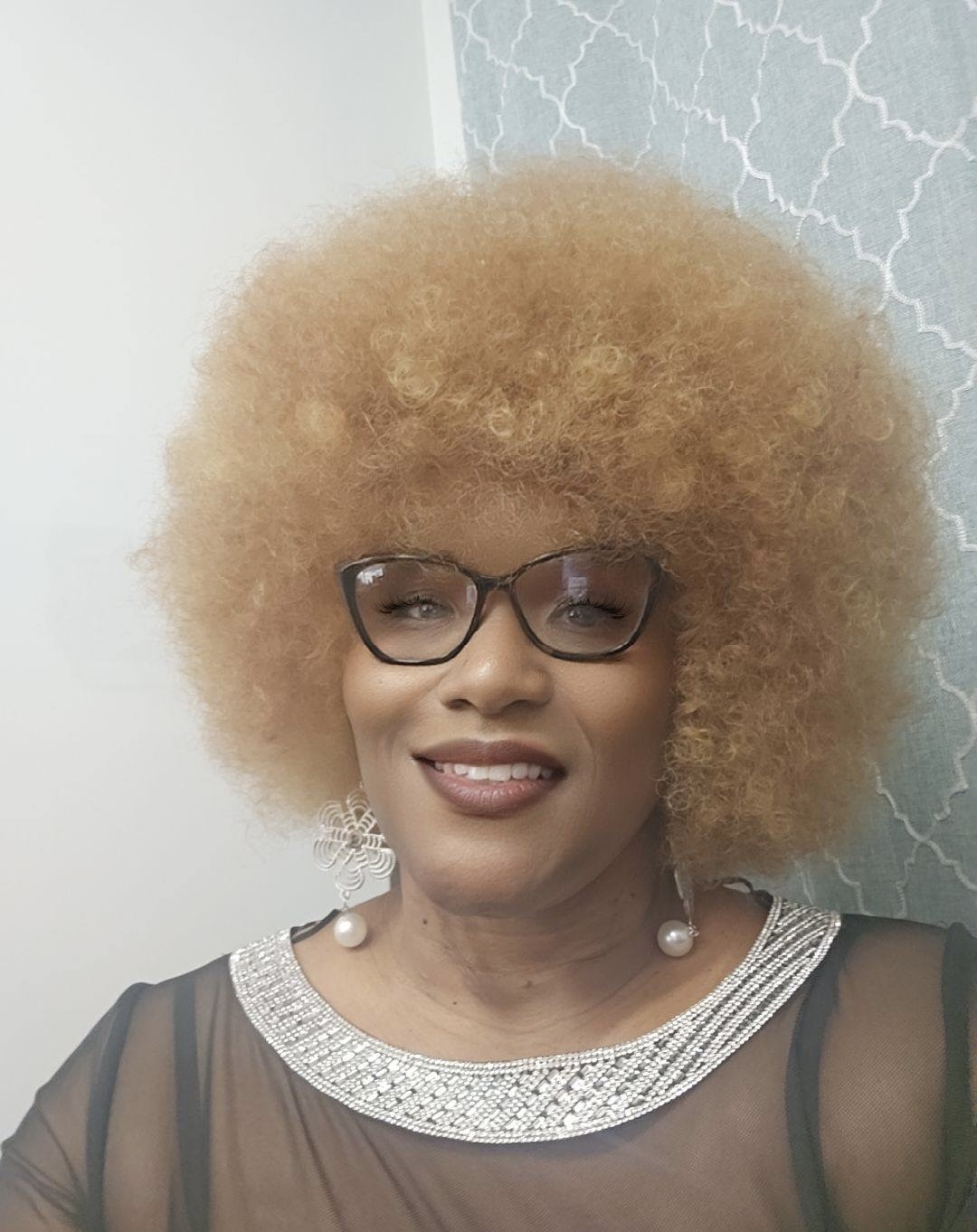
Felicia Kelly-Brookins is an award-winning author, screenwriter, and founder of S.A.F.E. S.P.A.C.E. TheaterTherapy
Foundation. Through storytelling and advocacy, she creates platforms that address mental health, emotional
wellness, and community empowerment.











One Response
We must prepare ourselves and we MUST learn to invest so that when things get difficult we have financial options with increased benefits.