7 min read
Major Takeaways
- Matthew Henson stood at the top of the world on April 6, 1909, ahead of every other man in his party.
- He mastered the Inuit language and the survival skills that kept the expeditions alive on the ice.
- Racism at home denied him credit for decades while Robert Peary collected the glory.
- The nation slowly corrected the record with Arlington honors, a Navy ship, and a medal bearing his story.
On the morning of April 6, 1909, Matthew Henson pushed ahead through blowing snow toward a point no map could mark.
There were no landmarks. There was only ice, wind, and the faith that eighteen years of trying had finally led somewhere.
When Robert Peary caught up about forty five minutes later, Henson greeted him with words that still echo.
He said he believed he was the first man to sit on top of the world.
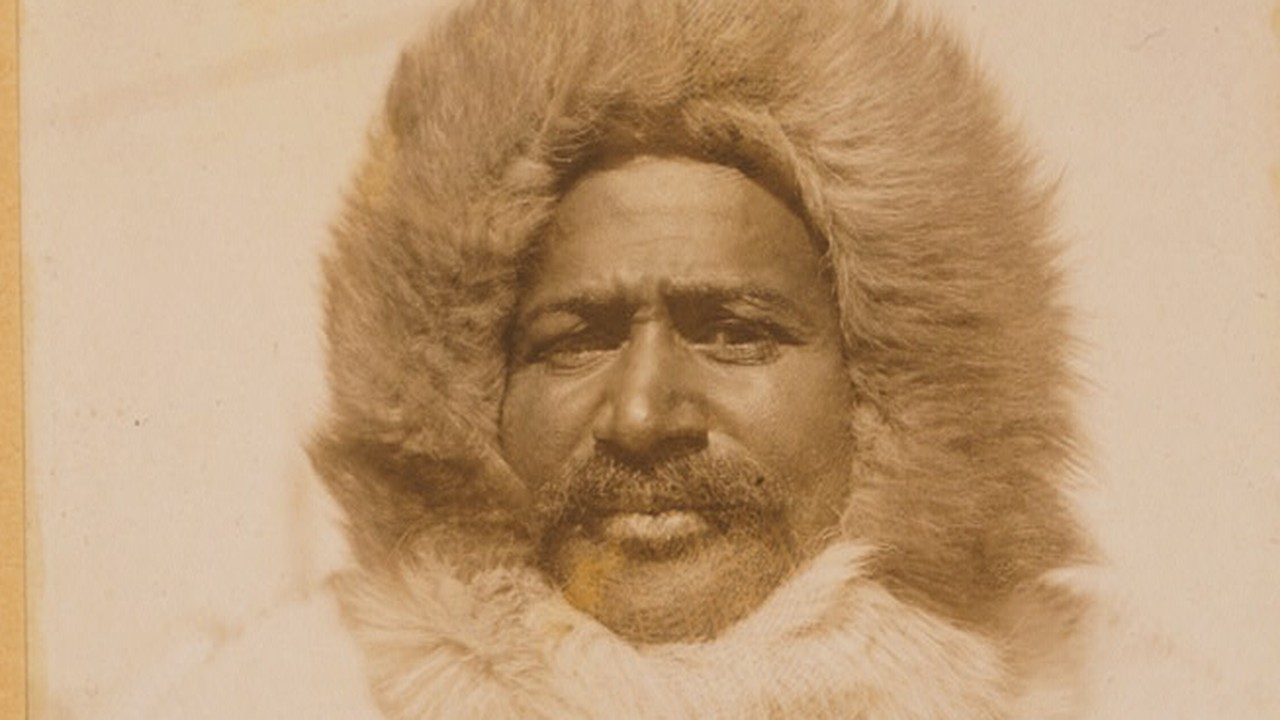
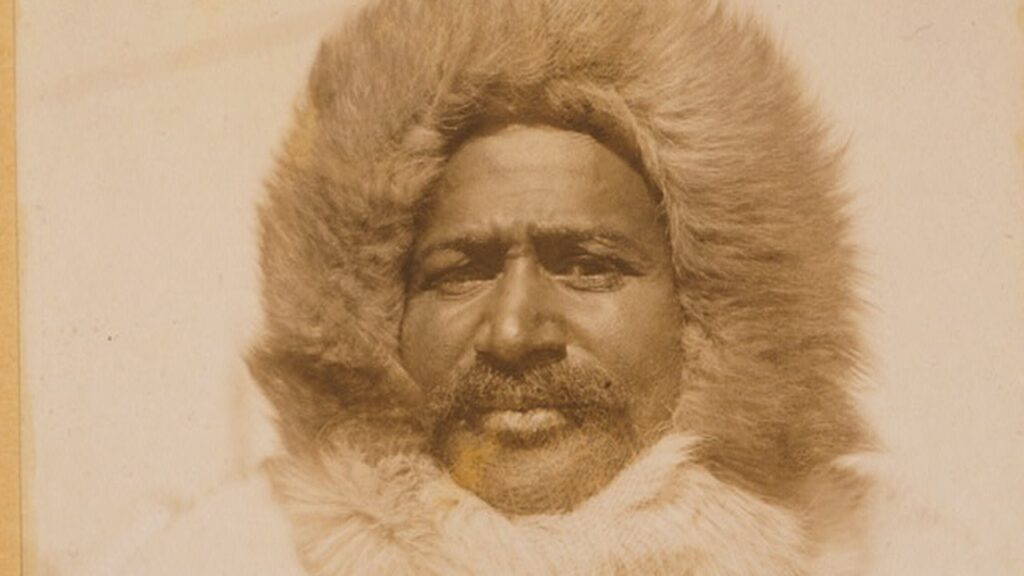
Matthew Henson in his Arctic fur suit. Photo courtesy of the Library of Congress, public domain.
A Maryland Orphan Learns the Sea
Matthew Alexander Henson was born on August 8, 1866, in Charles County, Maryland, near the Potomac River.
His parents were sharecroppers who had been free people of color before the Civil War. Both died while he was still a child.
At about twelve years old, the orphaned boy signed on as a cabin boy aboard the merchant ship Katie Hines.
Captain Childs took the boy under his wing. He taught Henson to read, to write, and to navigate by the stars.
For six years the young sailor crossed the world. He saw ports in Asia, in Africa, and across Europe.
The sea gave him an education no schoolhouse of that era would offer a Black boy from Maryland.
By 1887 he was back on land, clerking in a Washington hat shop, when a Navy officer named Robert Peary walked in.
Peary was preparing a canal survey in Nicaragua. He hired Henson as a valet, then quickly learned what the young man could do.
Henson handled the jungle work with skill and grit. Peary later admitted plainly that he could not get along without him.
Matthew Henson Becomes the First Man
In 1891 the two men sailed for Greenland. It was the start of seven Arctic expeditions across nearly two decades.
Henson did not simply assist. He became the craftsman, the navigator, and the interpreter every camp depended on.
He learned the Inuit language until he spoke it like a native. The Inuit called him Mahri Pahluk and treated him as one of their own.
He built sledges, trained dog teams, hunted for food, and raised igloos out of snow when shelter meant survival.
Historians note he was the only man on those crews, outside the Inuit themselves, who mastered driving a dog team the Inuit way.
Peary called him his first man. It was a title earned in temperatures that could freeze breath in the air.
Between expeditions, Henson even worked the rails for a time, part of the world of the Pullman Porters who carried Black labor across America.
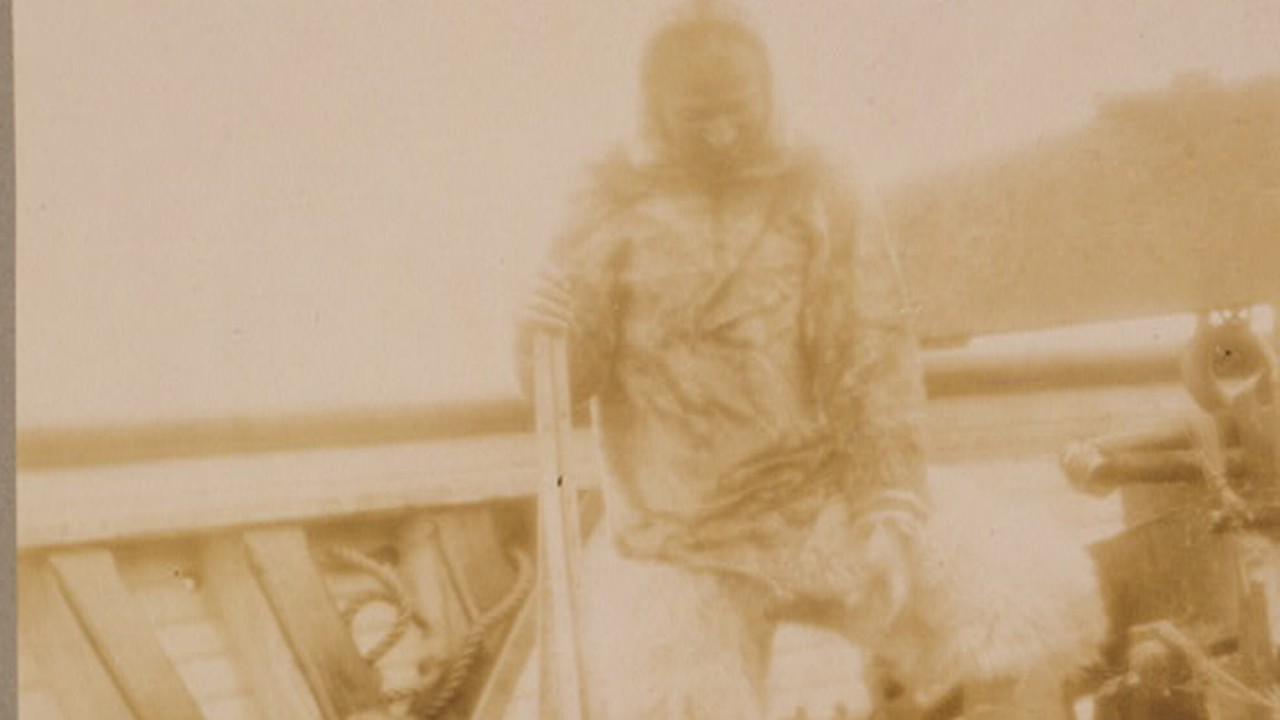
Matthew Henson aboard the Roosevelt in Arctic dress, with one of the sled dogs. Photo courtesy of the Library of Congress, public domain.
The Final March to the Pole
Attempt after attempt fell short. In 1900 the pair passed the farthest point north any explorer had reached.
In 1906 they beat their own record, stopping about one hundred seventy five miles from the Pole as broken ice turned them back.
In July of 1908 they sailed from New York aboard the Roosevelt for one last try. They wintered off Ellesmere Island and waited for the light.
In February of 1909 the march began with twenty four men, nineteen sledges, and one hundred thirty three dogs.
Support parties laid caches of food along the trail, then turned back one by one as the cold deepened.
For the final run Peary chose six men. They were Peary, Henson, and four Inuit teammates named Ootah, Seegloo, Egingwah, and Ooqueah.
Peary could no longer walk the last stretch. His toes were frozen, so he rode a sledge and sent Henson ahead to scout the trail.
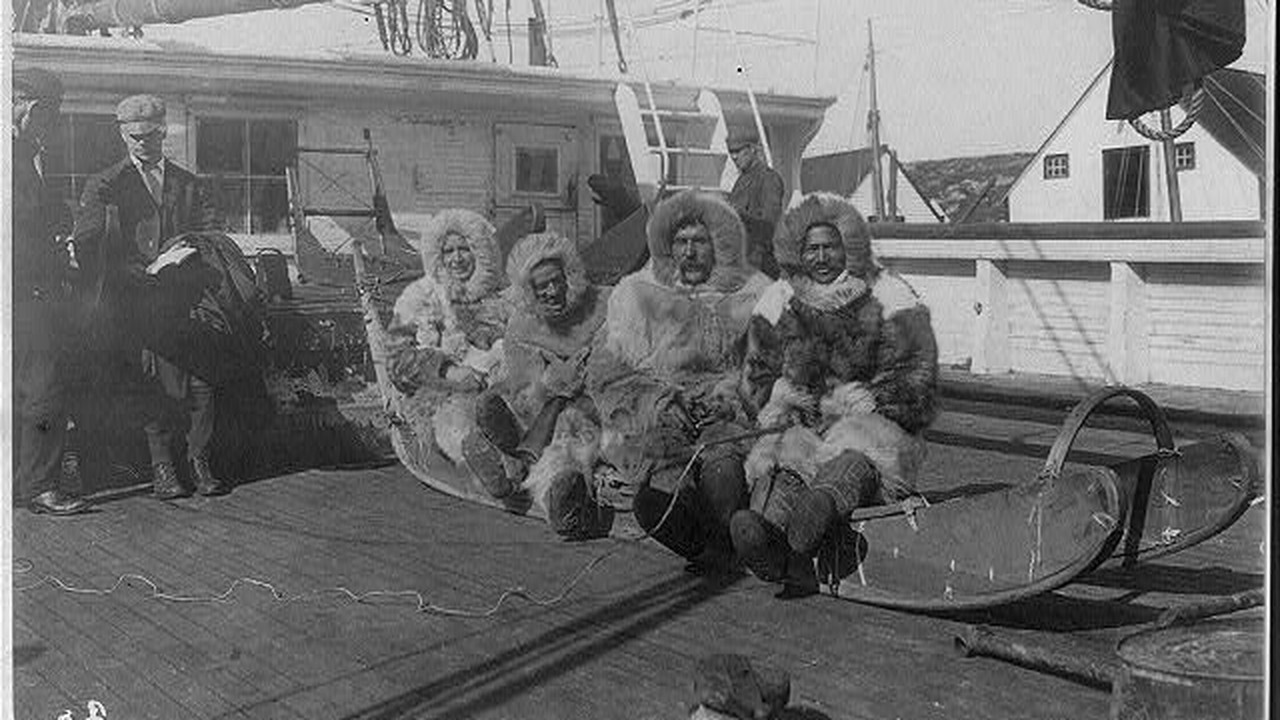
Expedition members, Matthew Henson among them, seated on the sledge that went to the North Pole. Photo courtesy of the Library of Congress, public domain.
Henson later told a newspaper that his lead party overshot the mark by a couple of miles, then doubled back.
He said he could see that his footprints were the first at the spot. At the top of the world, the first tracks were his.
Later researchers questioned how precisely anyone could prove a 1909 claim made with the instruments of that day.
What no serious account disputes is this. Matthew Henson was there, at the front, doing the work that made the arrival possible.
Glory for One Man, Silence for Another
America came home ready to celebrate a hero. It simply refused to celebrate both of them.
Peary received medals, fame, and a place in the history books. Henson was brushed aside in much of the press as a mere servant.
The Black community knew better. Churches, civic groups, and Black newspapers honored the explorer their country would not.
In 1912 Henson told his own story in his book A Negro Explorer at the North Pole. He toured the country and lectured about the ice.
Still, fame does not pay rent. In 1913, with backing from President Taft, he took a clerk job at the United States Customs House in New York City.
The man who stood at the top of the world spent more than two decades at a federal desk, largely forgotten by the nation he had served.
His story sits beside other builders of Black genius, like Benjamin Banneker, whose brilliance America praised late and credited slowly.
The Honors Arrived, Slowly and Then All at Once
In 1937 the Explorers Club finally opened its doors to him. At about seventy years old, he became its first Black American life member.
In 1944 Congress awarded him the Peary Polar Expedition Medal, the same honor created for the expedition crew.
His 1947 biography, written with Bradley Robinson, carried his story to a new generation of readers.
Presidents Truman and Eisenhower each welcomed him to the White House. The recognition was real, even if it arrived nearly half a century late.
Matthew Henson died on March 9, 1955, in the Bronx. He was eighty eight years old and was buried at Woodlawn Cemetery.
The story did not end there. In 1986 the nation put his face on a postage stamp.
On April 6, 1988, exactly seventy nine years after the great march, his remains were moved to Arlington National Cemetery with full military honors.
He rests there near Peary at last, not as a servant, but as an equal in the ground of heroes.
In 1996 the Navy named an oceanographic survey ship the USNS Henson in his honor.
In 2000 the National Geographic Society gave him its highest honor, the Hubbard Medal, accepted after his death by his great niece.
A generation later, astronomers even placed his name on the Moon, where a lunar crater now carries the name Henson.
Why Matthew Henson Still Matters Today
Every field has its Hensons. They are the people whose skill carries the mission while the credit lands somewhere else.
For Black readers, his story is proof that our people were never absent from the great adventures of history. We were written out of them.
There is a difference, and teaching that difference matters. Henson was not a footnote to another man. He was a master of his craft.
He learned a language the officers around him never bothered to learn. He earned trust the expedition could not buy.
When young Black explorers, scientists, and sailors look for a face at the frontier, his is one of the first they should find.
The trail is calling, Henson wrote at the close of his book. More than a century later, it still is.
Keep following the stories they tried to leave out at urbancitypodcast.com.