
Major Takeaways
King’s commitment to nonviolence was strategic, not soft, and reshaped American democracy.
His later work tied civil rights directly to economic justice and antiwar activism.
MLK’s legacy challenges today’s America to move beyond symbolism into real structural change.
Martin Luther King Jr.: The Man America Celebrates, But Still Struggles to Fully Honor
Every year on the third Monday of January, the United States pauses, at least symbolically, to honor the life and legacy of Dr. Martin Luther King Jr. Schools close, parades roll through major cities, corporate social media accounts dust off their favorite MLK quotes, and politicians who would have opposed him in the 1960s suddenly speak his name with reverence. But beyond the speeches, the memorials, and the recycled soundbites, the question remains: do we truly understand who Martin Luther King Jr. was, and more importantly, are we living up to what he stood for in today’s society?
Born on January 15, 1929, in Atlanta, Georgia, Martin Luther King Jr. entered a world deeply divided by race, law, and violence. The Jim Crow South was not just a backdrop to his childhood, it was the reality that shaped him. Segregation was not a theory; it was the daily structure of life. Black children were taught in underfunded schools, Black families were denied basic rights, and Black people lived under the constant threat of humiliation or harm simply for existing in white dominated spaces. King grew up watching this injustice, but instead of accepting it as permanent, he chose to challenge it.
His father, Martin Luther King Sr., was a pastor at Ebenezer Baptist Church, and his mother, Alberta Williams King, was a former schoolteacher and accomplished musician. Faith, discipline, and education were cornerstones of his upbringing. From an early age, King showed intellectual promise. He skipped grades in school, entered Morehouse College at just 15 years old, and later earned a doctorate in theology from Boston University. But intelligence alone does not change the world. What set King apart was his moral clarity and his willingness to act on it.
Inspired by both Christian theology and the philosophy of nonviolent resistance championed by Mahatma Gandhi, King believed that injustice could be confronted without hatred, that love could be a weapon, and that moral courage could outshine physical force. This was not a soft approach; it was a strategic one. Nonviolence required discipline, sacrifice, and a deep belief that exposing the cruelty of segregation would awaken the conscience of the nation.
King rose to national prominence during the Montgomery Bus Boycott in 1955. After Rosa Parks refused to give up her seat to a white passenger, Black residents of Montgomery, Alabama, organized a year long boycott of the city’s bus system. King, then just 26 years old, became the face of the movement. His home was bombed. His life was threatened. Yet he refused to back down. The boycott ended in victory, with the Supreme Court ruling that segregated buses were unconstitutional. That moment marked the beginning of a movement that would reshape America.
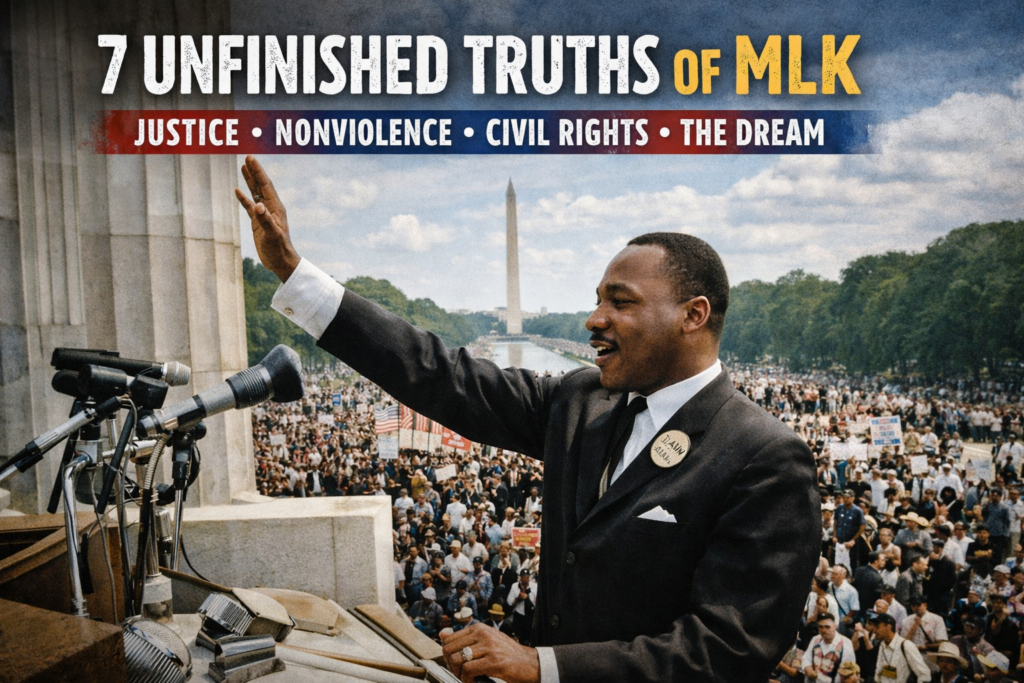
Throughout the 1950s and 1960s, King led protests, marches, and campaigns across the country. He helped organize the Southern Christian Leadership Conference, a major civil rights organization dedicated to nonviolent activism. He marched in Birmingham, where peaceful protesters were attacked by police dogs and fire hoses, images that shocked the nation. He led the Selma to Montgomery marches, where Black citizens demanding voting rights were brutally beaten on what became known as Bloody Sunday. And in 1963, he stood on the steps of the Lincoln Memorial and delivered his iconic “I Have a Dream” speech.
That speech was not just poetic; it was deeply political and radically American. King spoke of a nation that had promised freedom but failed to deliver it. He called out the hypocrisy of a country that celebrated liberty while denying basic rights to millions of its citizens. But he did not speak with bitterness; he spoke with hope. He envisioned a future where children would be judged not by the color of their skin but by the content of their character. That line is still quoted today, often by people who have little interest in actually confronting racial inequality.
In 1964, King became the youngest person ever to receive the Nobel Peace Prize, recognized for his leadership in the struggle for civil rights through nonviolent means. But while the world applauded him, many in America still despised him. He was monitored by the FBI. Politicians smeared him. Newspapers criticized him. Even some Black leaders believed he was moving too slowly or relying too much on integration rather than Black economic power.
And that is where today’s society often misunderstands King. He was not just a dreamer; he was also a radical critic of American systems. In his later years, he spoke out against poverty, economic inequality, and the Vietnam War. He believed that racial justice could not exist without economic justice, and that true freedom meant more than just the right to sit at a lunch counter. It meant fair wages, decent housing, and real opportunity.
In 1968, King launched the Poor People’s Campaign, an effort to unite Americans of all races in a fight against economic injustice. He planned to bring thousands of impoverished citizens to Washington, D.C., to demand jobs and livable incomes. This was not comfortable activism. It challenged the political and economic elite. And that challenge likely made him even more dangerous to those in power.
On April 4, 1968, Martin Luther King Jr. was assassinated in Memphis, Tennessee, where he had gone to support striking sanitation workers. He was only 39 years old. His death sparked riots across the nation, a raw expression of grief, anger, and frustration. America had lost not just a leader, but a moral compass.
More than five decades later, MLK Day has become a national holiday, but the country he dreamed of is still unfinished. Racial disparities in wealth, education, healthcare, and criminal justice persist. Police brutality continues to claim Black lives. Voting rights are still under attack. And yet, King’s legacy remains powerful because it refuses to let America off the hook.
In today’s society, his message is as relevant as ever. At a time when political division feels deeper than ever, King reminds us that change requires both courage and compassion. In an era of social media outrage, he challenges us to move beyond performative activism and toward real action. In a world where inequality continues to grow, he calls us to remember that justice is not optional, it is essential.
Celebrating Martin Luther King Jr. should not be about quoting one speech and calling it a day. It should be about asking uncomfortable questions. Are we truly committed to equality? Are we willing to stand up against injustice even when it is inconvenient? Are we prepared to sacrifice comfort for progress?
King once said, “Injustice anywhere is a threat to justice everywhere.” That line should echo through every school, workplace, and government institution in America today. His dream was not just for Black people; it was for the soul of the nation. And that dream is still very much alive, but it requires more than ceremonies and commercials. It requires action.
So as parades roll, speeches are given, and schools close, let us remember the real Martin Luther King Jr. Not the sanitized version. Not the safe version. The man who challenged power, demanded equality, and believed that love could transform a broken world. If America truly wants to honor him, it must stop treating his legacy like history and start treating it like a responsibility.
And if we are honest, we still have a long way to go. But as King himself believed, the arc of the moral universe is long, but it bends toward justice.