
4 min read
Dallas City Hall is not going anywhere unless the people of Dallas say so. That is now the demand, and it arrived with about 35,000 signatures behind it.
On Wednesday, November 18, the Save Dallas City Hall Coalition turned in its petitions at 1500 Marilla Street.
The group needed 20,000 signatures to force the issue onto the ballot. It collected roughly 35,000 in 30 days, more than double the requirement.
The goal is a change to the city charter. If voters approve it in May 2027, the city cannot leave Dallas City Hall unless the voters themselves give permission first.
A Building With a Story
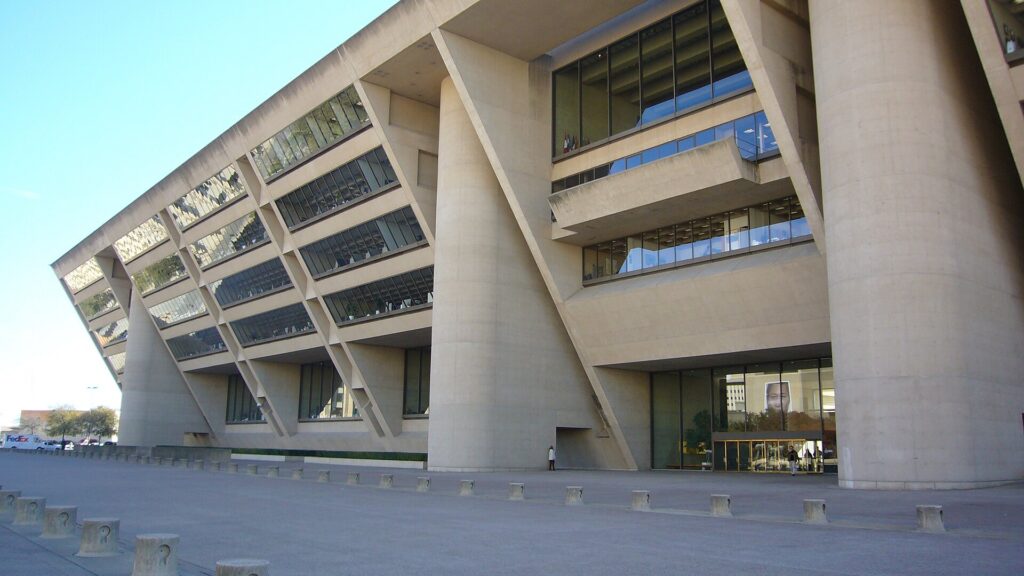
Dallas City Hall opened in 1978, designed by I.M. Pei, one of the most celebrated architects in the world.
Its sloped concrete face is unlike any other seat of government in Texas. People either love it or argue about it, but nobody mistakes it for anything else.
The plaza in front of the building has hosted rallies, vigils, and celebrations for nearly five decades. It is one of the few truly public stages the city owns, and it belongs to everybody.
For Black Dallas, the building is more than architecture. It is where residents pack the chamber to fight for city services, where budgets get decided, and where neighborhoods south of the river have demanded their fair share for decades.
Talk of the city walking away from the building landed the way it did because history matters here. Public assets in Black communities have been neglected, sold, and erased before, usually after decisions were made in rooms the public never entered.
The Number Nobody Agrees On
The loudest argument in this fight is about one number.
The city says the building needs $329.4 million in repairs. The coalition disputes that figure, and points to an assessment from 2018 that put the repair bill at $18.9 million.
That is a gap of more than $300 million between two readings of the same building.
Coalition members argue that years of deferred maintenance made the problem look bigger than it is, and that a building allowed to decay becomes easy to abandon.
City leaders who favor a move say the cost of staying is real money that could serve residents in other ways. Both sides cannot be right about the math, and the voters may end up grading it.

A Lawsuit Already Running
The petition drive is not the coalition’s only move.
In August 2026, the group sued the city, alleging demolition by neglect. The claim is that the city let its own landmark fall apart so that leaving would look like the only choice.
The city has asked a judge to dismiss the case. A ruling is expected by December 31.
That ruling will land months before any vote, and it could reshape the whole fight.
What Happens Next
The city secretary now verifies the signatures, checking the petitions name by name.
If enough signatures hold up, the council is expected to call the election around February, setting up the May 2027 vote.
Between now and then, both sides will make their case in public. The coalition has already shown it can organize. City leaders who want the move will have to sell it to the same voters who just signed in numbers too big to ignore.
Fifteen people sit on the Dallas City Council. The coalition’s answer to that math is 35,000 names on paper.
The lesson travels well beyond one building in one city. When residents organize early, gather in public, and use the tools the charter gives them, decisions that looked settled in a back room have to survive daylight.
Dallas voters will get the final word on their own City Hall. The coalition made sure of it, one signature at a time.
Major Takeaways
The coalition turned in about 35,000 signatures, more than double the 20,000 required, gathered in 30 days.
The charter change would require voter approval before the city can leave Dallas City Hall at 1500 Marilla Street.
The city cites a repair bill of $329.4 million, while a 2018 assessment put repairs at $18.9 million.
The coalition has also sued the city over neglect of the building, with a ruling expected by December 31.
Photo: Dallas City Hall, the I.M. Pei building at 1500 Marilla Street. Photo by Kent Wang, Wikimedia Commons, Creative Commons Attribution ShareAlike 2.0.