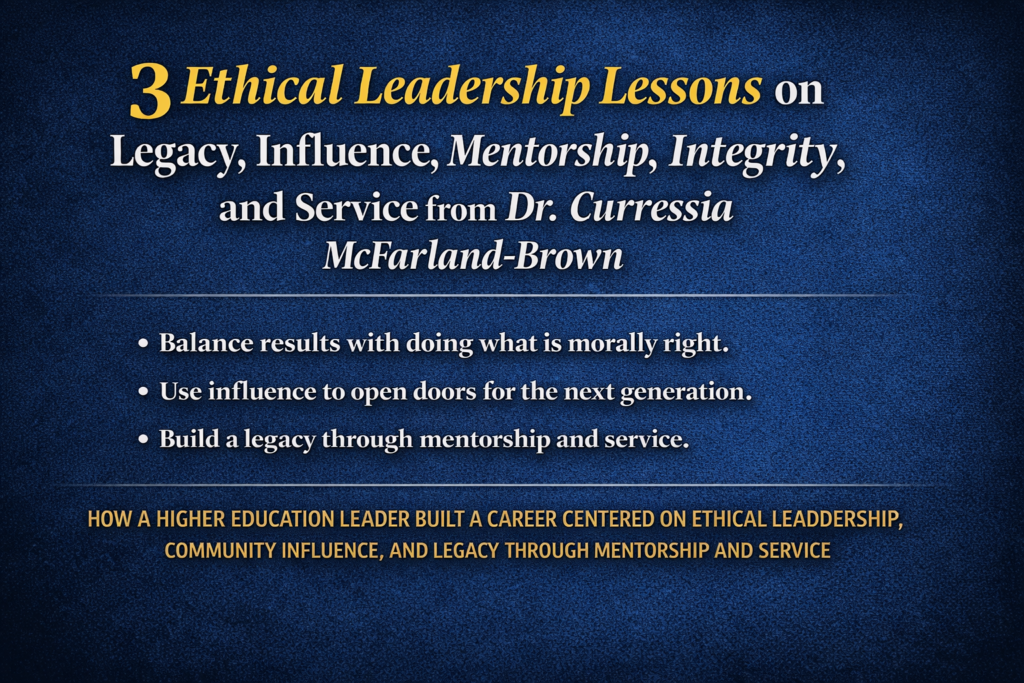
3 Ethical Leadership Lessons on Legacy, Influence, Mentorship, Integrity, and Service from Dr. Curressia McFarland-Brown

Urban City Podcast Group
Dr Curressia McFarland Brown leadership interview on ethical leadership legacy and mentorship
Dr. Curressia McFarland-Brown reflects on ethical leadership, influence, mentorship, integrity, and service after a 34-year career in higher education. Her insights reveal how intentional leadership builds lasting legacy and opens doors for future generations.
Urban City Podcast Group
United States Real Estate Investor® Property Profit Powerhouse
Urban City Podcast Group

Table of Contents

Urban City Podcast Group
Dr Curressia McFarland Brown leadership interview on ethical leadership legacy and mentorship
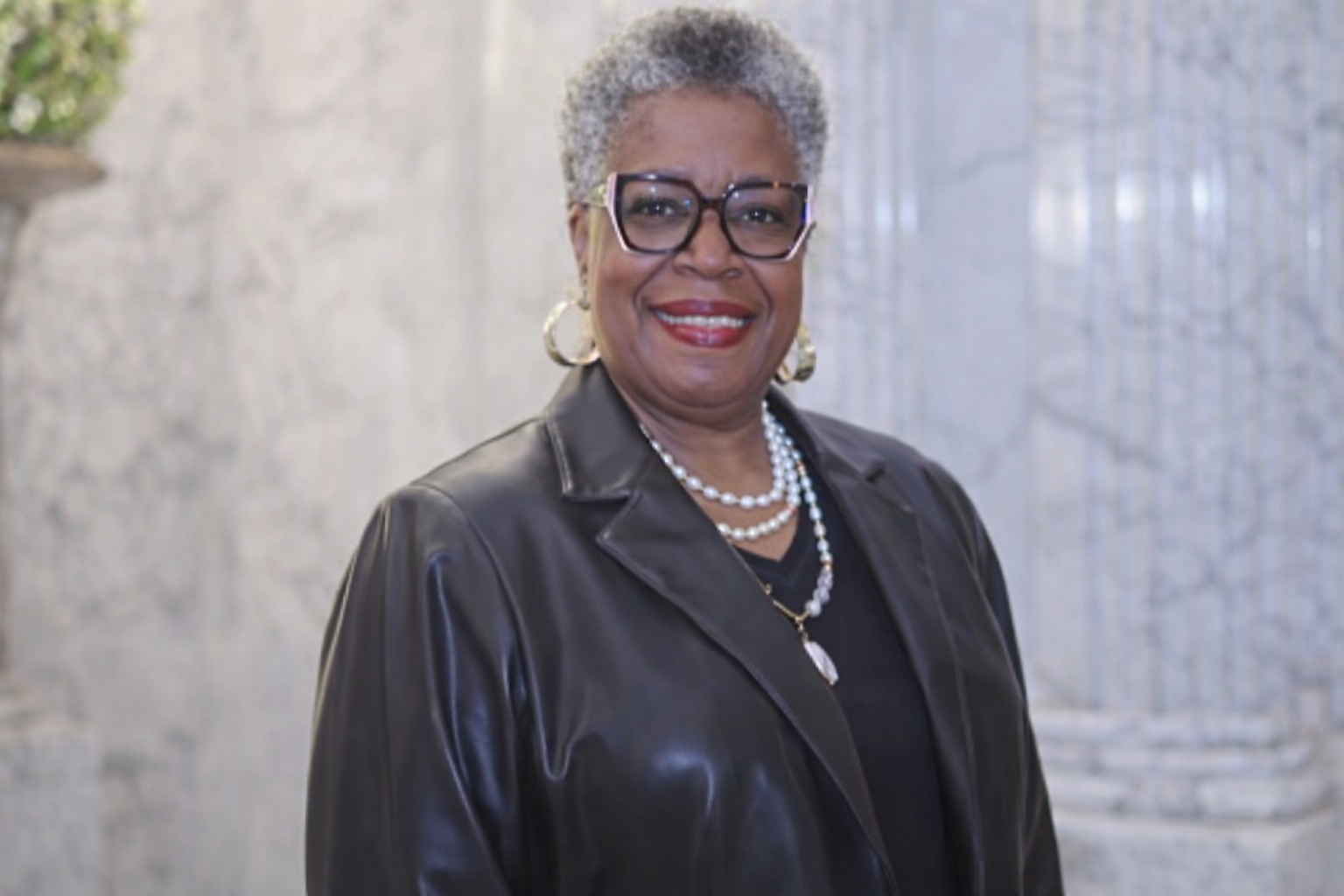
WHM Presented By Urban City Podcast Photo Credit: Dr. Curressia McFarland-Brown
 

Major Takeaways

  • Ethical leadership requires balance between achieving results and doing what is morally right for the people affected by those decisions.

  • Influence carries responsibility, especially for women leaders opening doors for the next generation.

  • Legacy is built through mentorship and service, not simply through titles or professional accomplishments.

How a Higher Education Leader Built a Career Centered on Ethical Leadership, Community Influence, and Legacy Through Mentorship and Service

Q&A With Felicia Brookins• WHM Presented By Urban City Podcast 5 min read Architects of Impact: The Executive Legacy Conversation About the Architects of Impact Series Architects of Impact is an executive spotlight series highlighting accomplished women 50+ who lead with strength, softness, and strategic clarity. These in-depth conversations go beyond titles to uncover the “why” behind their work, the responsibility of influence, and the intentional legacy they are building for the next generation. Architect of Impact: Dr. Curressia McFarland-Brown Full Name: Dr. Curressia McFarland Brown Current Title: Retired, University Administrator Organization/Institution: Mississippi Valley State University (Retired 12/2001) Occupation/Professional Field: Higher Education Number of Years in This Profession: 34 You occupy spaces where decisions carry weight and consequence. How would you define your leadership philosophy, and how has it evolved as you have moved into positions of greater authority? Response: My leadership philosophy is embodied in nine, simple words: “Do the thing right, and do the right thing.” “Doing the thing right” is a reference to accomplishing established goals and meeting performance and productivity expectations. “Doing the thing right” is a reference to empowering others and encouraging their growth and well-being. This philosophy enables me to balance decisiveness with empathy, to respect the task and those responsible for performing the task. Maintaining this “balance” is my greatest strength as a leader. A defining moment that reshaped how I lead was a moment in my career when I felt the least valued/respected as an administrator. The knowledge, skill and aptitude that I brought “to the table” was ignored (at best) and discounted (at worse). The professional attacks were open and obvious – even to the point at which the academic well-being of students was threatened. This experience motivated me to become more intentional, most deliberate in avoiding the same behavior with those under my supervision. Titles describe what you do, but rarely capture why you do it. What is the deeper “why” that anchors your work, and how does it influence the way you show up each day? Response: My “why” is a commitment “planted” by my parents, “watered” by my lived experiences, and “pruned” by community. At the feet of Curby and Ruby McFarland, I learned that my talents and abilities are gifts from God. Inherent in those gifts is the obligation and expectation to serve. My life’s journey, the challenges and triumphs, reinforced those early lessons and equipped me to identify opportunities to “do good.” My experiences as a student, a professional, a wife and mother fine-tuned the ability to discern and sharpened skills necessary for growth amid pressure and expectation. How do I remain aligned? I approach each day determined to be the change I wish to see. As a woman in executive leadership, how do you interpret the responsibility that comes with Influence and how do you navigate power dynamics in spaces where women have historically been underrepresented? Response: I navigate power dynamics in spaces where women have been historically underrepresented by entering those spaces and taking my seat at the table – unashamedly, unapologetically. I move in those spaces with expertise, understanding and recognition of my responsibility to shape culture and open doors for the women who will follow me. At the same time, I am conscious of my responsibility to mentor those for whom space/ a place has been prepared. Being “in the room” or “at the table” is not (in my opinion) to be celebrated only as an individual or personal accomplishment, but as an opportunity for “community” elevation. That community” The next Sister(s). Ethical leadership is “the ability to do the right thing while doing the thing right.” Ethical leadership recognizes the legal right to engage in a particular behavior or practice does not mean that the particular behavior or practice is the fight thing to do. Leadership extends beyond institutional walls. Please share the organizations or causes you are actively involved in and why they matter to you. Response: Providence Missionary Baptist Church: My faith tradition is the firm foundation for all that I do and all I aspire to accomplish. Denominational leadership and engagement (at the local, state and national levels) are platforms for reaching the next generation and for advocating on their behalf. Delta Sigma That Sorority, Incorporated: As part of the National Social Action Commission of Delta Sigma Theta Sorority, Incorporated, I am engaged (albeit immersed) in issues impacting our communities (including social justice, economic justice, educational justice, health equity). Women for Progress of Mississippi: Though geographical constraints limit my in-person involvement as a member of this organization, its principles, mission and vision are directly aligned with my purpose and presence in community. When the next generation studies this era of leadership, what do you hope they will understand about the women who led during it? Response: To the next generation of emerging women, I would whisper, “Yes, Queen Sister, you can.” The path will not always be straight, there will be pitfalls and snares, there will be challenges and triumphs. There will be glass ceilings and glass cliffs. “Yes, Queen Sister, you can.” What does legacy mean to you, and how are you intentionally building it? Response: Legacy, for me, is not measured by the titles I’ve held, the roles I’ve played, the positions to which I have been assigned. Legacy it is what I have inspired in others. Recently, I heard the remark (perhaps on social media) that some people will only be remembered because of a tombstone. I want to be remembered for opening doors, impacting community, creating “braves spaces” for those historically and systemically underestimated and underrepresented. I am intentionally creating legacy by intentionally investing in the next generation.
Urban City Podcast Group
United States Real Estate Investor® Property Profit Powerhouse
Urban City Podcast Group

Comments (0)

Your email address will not be published. Required fields are marked *

Urban City Podcast Group
United States Real Estate Investor® Property Profit Powerhouse
Urban City Podcast Group
loader-image
,

Urban City Podcast Weather sponsored by

Urban City Podcast Group

Get the latest news, events, and subscriber-only offers when you subscribe to the Urban City Podcast newsletter! Subscribe now!

Urban City Podcast Group

SHARE THIS ARTICLE

Urban City Podcast Group

Articles You May Like

Urban City Podcast Group

ADVERTISERS