

Major Takeaways
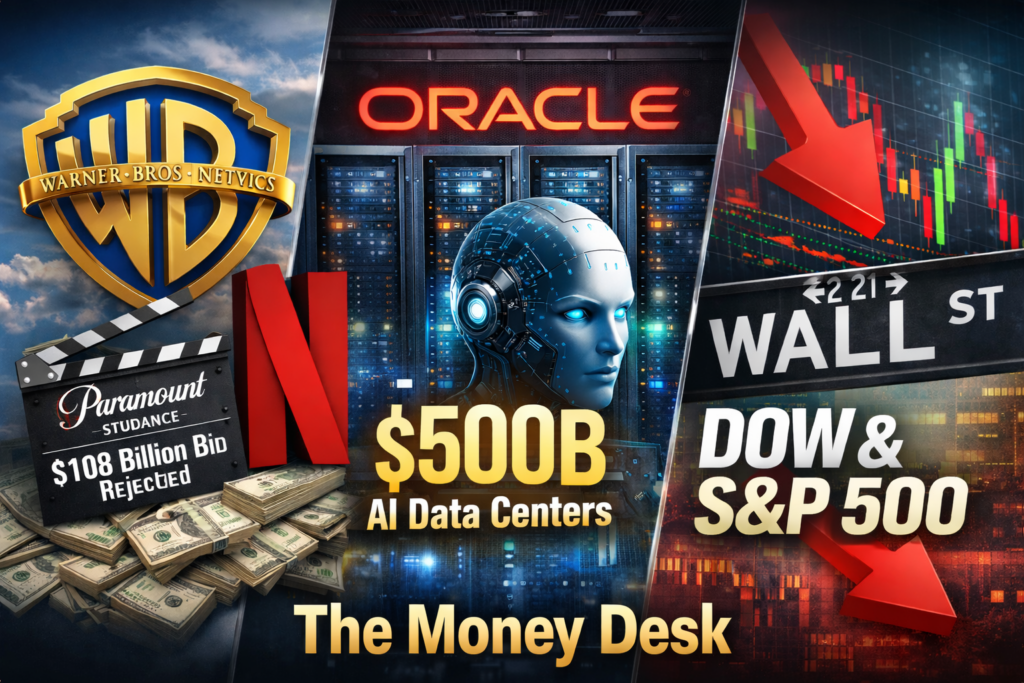
• Deal certainty now beats big numbers. Warner Bros choosing Netflix over a larger Paramount bid signals a major shift in corporate dealmaking where reliable financing and regulatory clarity matter more than headline valuations.
• AI dominance comes with a massive price tag. Oracle’s central role in a $500 billion AI data center expansion highlights both the opportunity and the financial risk of locking into long term infrastructure bets.
• Markets are pausing to reassess reality. Pullbacks in the Dow and S&P 500 reflect investor caution as tech valuations stretch and interest rate uncertainty clouds near term expectations.
This is Urban City’s The Money Desk.
We begin today’s headlines at intersection of media power money and the future of entertainment and it is one that Wall Street and Hollywood are watching very closely.
Warner Brothers Discovery has made its position clear. The company is backing a strategic deal with Netflix and turning away from a much larger headline grabbing bid from Paramount Skydance valued at more than one hundred eight billion dollars. On paper that Paramount offer looked enormous. It was designed to stop the Netflix deal in its tracks and force Warner Brothers shareholders to consider an all cash alternative that would have reshaped the media landscape overnight.
By contrast the Netflix agreement provides what Warner Brothers leadership describes as clarity. The financing is secured. The timeline is defined. And the strategic direction aligns with where audiences are actually consuming content. Streaming is no longer the future. It is the present. Netflix brings scale global reach and a data driven distribution machine that traditional studios simply cannot replicate on their own.
If the Netflix deal moves forward it would represent one of the most consequential partnerships in modern media history. Warner Brothers content from blockbuster films to premium television would be more tightly integrated into a global streaming platform with hundreds of millions of subscribers. That has implications for theatrical releases licensing models creative control and how talent negotiates compensation.
For consumers it likely means faster access to premium content and fewer fragmented subscriptions. For competitors it raises the pressure to scale or partner or risk being left behind. And for regulators it presents another test case in how far they are willing to let tech and media converge under one roof.
Shifting from Hollywood to Silicon Valley and the enormous bill coming due for artificial intelligence.
Across the technology sector companies are committing an estimated five hundred billion dollars to data center leases infrastructure projects and long term capacity agreements designed to support AI workloads. At the center of this spending spree is Oracle.
Oracle has emerged as a major player in the race to build and secure AI ready data centers. The company has been signing long term leases and partnering with infrastructure developers at a pace that has caught the attention of investors analysts and credit markets.
This is not speculative spending. These are binding commitments often stretching decades into the future. They require massive upfront capital and assume that demand for AI compute will grow fast enough to justify the cost.
Oracle’s role is especially notable because it is not just renting space. It is structuring complex partnerships that blur the line between cloud provider real estate investor and financier. That gives Oracle a chance to gain share in a market long dominated by a handful of hyperscalers. It also exposes the company to greater balance sheet pressure if returns do not materialize as expected.
This spending wave is reshaping local economies as well. Data centers demand enormous amounts of electricity and water. Communities that host them see investment and jobs but also face infrastructure challenges. Power grids are being upgraded land prices are rising and municipalities are negotiating tax incentives and environmental protections.
Now to the markets where investors are recalibrating expectations.
U.S. stocks traded lower today as technology shares pulled back from recent highs. The Dow Jones Industrial Average slipped modestly while the S and P 500 declined as well. The Nasdaq saw more pronounced pressure reflecting investor caution around richly valued tech and AI related names.
This pullback comes after a powerful rally that pushed major indexes to elevated levels. Investors are now asking a familiar question. How much good news is already priced in.
Technology stocks have been the engine of market gains this year. They are also the most sensitive to changes in interest rate expectations. Higher rates reduce the present value of future earnings and AI driven valuations assume a lot of future growth.
Meanwhile defensive sectors have shown relative stability as investors rebalance portfolios. Energy and commodities have moved on supply dynamics and geopolitical developments reminding markets that inflation risks have not disappeared entirely.
Bond yields have fluctuated as traders assess what the Federal Reserve will do next. Any indication that rates will stay higher for longer tends to pressure equities. Any hint of easing provides temporary relief.
What ties today’s stories together is capital allocation. Warner Bros choosing certainty over a bigger bid. Tech companies locking in massive infrastructure commitments to chase AI dominance. Markets weighing whether current prices reflect realistic outcomes or optimistic projections.
As always we will continue to follow these developments closely bringing you clear context without the noise.
For this story and more stay locked in to urbancitypodcast.com and download the Urban City Podcast app!