
Major Takeaways
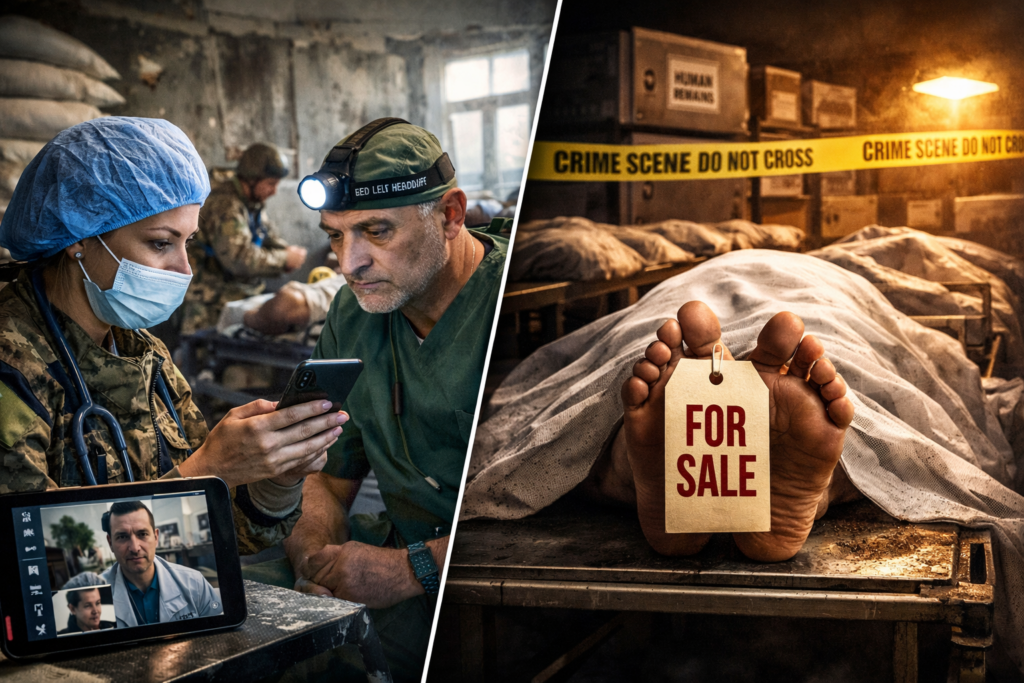
America’s body donation industry operates with shockingly little regulation leaving families and donors vulnerable to exploitation
Ukrainian doctors are using medical apps and peer to peer support from global physicians to save lives during wartime
Technology is filling deadly healthcare gaps where governments and systems have failed
Body Donation and Ukraine Doctors Using Medical Apps
You’re listening to Radio Health Journal, the trusted news source for medicine, science and technology. I’m Elizabeth Westfield. I’m Mayan Vasta Betancourt.
And I’m Greg Johnson. This week, doctors helping doctors in war-torn Ukraine via a medical app that offers clinical support during a crisis. 5,000 physicians in Ukraine that are using the app.
We also have specialists from all over the world who are giving peer-to-peer review. But first, who’s making sure our loved ones’ remains are safe? The donor having the autonomy, even if they’re not there anymore, they don’t oppose the fact that they’re being donated is really important. All that and more this week on Radio Health Journal.
Have you heard the story that’s about a guy who lives in a bank that is really close by? The Capital One Cafe is his home, no doubt, where customers bank and get their cash out. There’s no fees or minimums on checking accounts, so your money stays. Most Capital One Cafes are open all seven days.
This magical place, as some people might call it, is where the Capital One bank guy says, what’s in your wallet? That’s a lovely tale. Terms apply. See CapitalOne.com slash bank for details.
Capital One and a member FDIC. At Charmin, we heard you shouldn’t talk about going to the bathroom in public, so we decided to sing about it. Light a candle, pour some wine.
Grab a roll, the soft kind for a little me time. Charmin Ultra Soft Smooth Tear. Wavy edges for my rear.
So let the softness caress your soul. Just relax, you’re on a roll. Let it rip.
Charmin Ultra Soft Smooth Tear. Charmin Ultra Soft Smooth Tear has the same softness you love. Now with wavy edges that tear better than the leading one-ply brand.
Enjoy the go with Charmin. Organ donation is a highly regulated system to protect both the donors and recipients. Federal and state laws protect against exploitation and trafficking while ensuring a fair and ethical process.
But what’s surprising is that this strict oversight doesn’t really apply to the rest of the body. Each year, thousands of people donate their bodies to science to be used for medical education or research purposes. But aside from a 1968 law, the human body donation market is essentially the Wild West of science.
Joy Balta says this lack of oversight and regulation has led to a dangerous absence of accountability for this industry. We know nothing actually about what happens. So some of the research that I’ve done and my PhD students have looked into was asking body donation programs about kind of what they do, their operations.
We’ve had donation programs that have refused to be part of the survey. Some of them said that their even administration advised them not to participate because that would maybe put them at higher risk and being exposed to kind of what’s happening, what they’re doing. Balta is a professor of anatomy and founding director of the Anatomy Learning Institute at Point Loma Nazarene University.
He says that we shouldn’t assume all donation centers are operating illegally or unethically. But there’s a lot of fear of what could be happening due to this lack of oversight, as well as past cases. Over the years, various companies in this industry have been exposed for using bodies without consent, illegally selling body parts and desecrating the remains.
Some notable cases have involved the bodies of loved ones being sold to the Department of Defense and used without consent in explosion and vehicle crash testing. There should be some law to ensure that illegal activities are not happening and stuff happens all the time. There’s been, I’m not going to necessarily name kind of cases, but there’s multiple cases that are from last year and the year before and the year before that.
So we’re not living in history. This is still happening today and it’s going to continue to happen until we do regulate the space. There’s always going to be some bad actors that are going to abuse the fact that there is no oversight for their best interest.
In an effort to establish some sort of guidelines, the American Association for Anatomy created a task force to come up with the best practices and recommended standards. It was published in 2024, but Balta, who is a contributor on the project, says the finished product was years in the making. It took years to be able to establish a committee and then it took years to build those best practices.
It wasn’t a short process. There were multiple people involved in that document. Each of us came from different backgrounds.
Some of us are faculty teaching anatomy. Some of us are administrators of body donation programs. I was the director of the body donation program and encyclical services at Ohio State University at the time.
With so many different perspectives, Balta says it took a while to create a document that everyone agreed represented a fair and ethical perspective on human body donation. The long process also may have stemmed from the fact that there had never been anything like this published before, meaning that an entire industry profiting off the sale of human remains has been operating without official guidelines and continues to function without any meaningful oversight. That was the first comprehensive best practices document.
Unfortunately, there aren’t even laws around some of those areas. So we are asking people to be ethical and follow best practices, even though there isn’t a regulatory body that oversees this and ensures that it’s being mandated. We’re just hoping that people and their leadership would kind of push to use those best practices to ensure that we’re advocating for those donors and we’re treating them in the most ethical way after they’ve given their bodies to us, after they’ve passed.
Balta hopes this document informs future legislation, but that dream may be far from coming true. The Uniform Anatomical Gift Act, passed in 1968, is the most universal law we have for donations. It mainly dictates who can authorize an anatomical donation and gives guidance on that process.
However, it doesn’t really touch on what the expectations are after a body is donated. There’s kind of some oversight in some states. So, for example, there’s like a board, an anatomical gift board in Florida, that in theory there should be overseeing, but they don’t have any legal authority to implement anything.
So like if they want to inspect something, they don’t have the authority to demand that. They don’t have the authority to enforce something. So there’s no legal power behind their work.
But yeah, different states do have different applications of it and it varies per state, but does not go into the post-donation part when we are working with the donor, when the donor is in the facility. So you have a chain of custody. The donor leaves the mortuary, comes to the facility, and that’s it when it comes to kind of paperwork until it leaves the facility.
There’s essentially no governing body doing checks on these facilities to make sure that these companies are running their operations safely and ethically. Balta says that most of the cases of illegal activity we know about are because of insider whistleblowers or family members of a donated body. That only shows you that there could be more happening.
We’re just waiting for things to kind of come out for us to know about it. But while this has been the standard of practice in America for decades, Balta says it’s much different in other countries. So I trained and taught in Europe.
So I studied in Scotland and I taught there and in Ireland. And they have inspectors. There’s an inspector of anatomy.
Somebody who comes and inspects the facilities, inspects the documentation, has the authority to shut down a body donation program. In the UK, there is the King’s inspector at the moment of anatomy, and that’s their job. There’s the Human Tissue Act that governs the space.
And it’s well managed. You don’t hear about there aren’t stories that come out like that over there because there’s more oversight, because there are people working to ensure that that doesn’t happen. Balta says a main hurdle to having those same standards in America is having to get all the states on the same page.
I’m not saying that that’s a reason not to. What I’m saying, it just makes it a little bit harder. But also politics is politics.
There needs to be a good reason for something to be pushed through the agenda. If it’s not loud enough, then politicians, I’m not sure that it’s going to be going on their agenda, on the priority list of their agenda. And we’re not even close.
We’re not even kind of having the conversations that hopefully one day we will. We’re not. We’re not having that conversation.
I think hopefully we’re able to start that conversation soon. There are a few points Balta thinks need to be at the top of these discussions, one being how we treat unclaimed bodies. Earlier this year, Radio Health Journal released a segment revealing the thousands of bodies in America that go unclaimed each year.
Instead, they’re left to the state and usually cremated. However, most counties are allowed to donate these remains to science without consent from the deceased or their family. A 2023 paper published in JAMA looking at Texas medical schools found that their use of unclaimed bodies jumped from 64 bodies in 2017 to 446 in 2021.
But is that unethical? Since it falls into a gray area for many people, it’s a topic Balta believes needs more attention and guidance. This body is contributing towards science and benefiting science and advancing medicine. But that’s not a good enough reason to kind of donate the body or give it away.
It’s not even donated, it’s being given without knowing that this could be somebody who had religious beliefs that could go against that. And that’s not OK. We shouldn’t be making those decisions for financial reasons, the ethical reasons and considerations of that human body should come first.
We can’t just assume that they’re OK with it or that because they were unclaimed were able to benefit from their donation. Another priority for Balta is making sure donation programs all have a transparent and standard structure for applications. Consent forms can vary drastically from one institution to the next.
Balta says that some completely refuse to disclose how they’ll use the body once it’s donated. Many forms list what types of research could be done to the body, but some don’t even give an option to opt out of anything the donor or loved one is uncomfortable with. Yes, it’s good to know that these are the ways I’m going to be donating my body to.
But can I say I don’t want to? And I think we might have like a place where they can write comments, but we don’t give like a checkmark like yes for this, no for that, yes for that. And there are multiple reasons for that. But yeah, I think that would be really helpful that people are aware.
And in some places, the consent form says it’s just one sentence. I am donating my body to this donation program. That’s it doesn’t go through their rights, doesn’t go through what’s going to happen after disposition of the human remains.
Usually forms are multiple pages, but you could have a form that is one sentence. Balta has published research looking through consent forms across the U.S. and notes how drastically these applications can vary. But if we zoom out and look at the industry as a whole, a larger issue may be the fact that parts of the human body donation industry are for profit.
Balta and the rest of the task force argue in their paper that the most ethical way to be conducting business in this field is to operate under revenue neutrality. While most university programs are nonprofit, there are other companies actively profiting off the sale of human remains. There are the body donation programs that are staff of a university.
There are faculty members, but they don’t like they’re not working for themselves. They’re not trying to make money that they’re going to benefit from. And hopefully they’re working towards the revenue neutrality.
But that’s what we’re trying to push for. The for profit companies don’t have to think about that. They don’t have to.
And some of them are. I don’t want to kind of lump everybody. Some of them are better than others.
Can we say like, oh, we don’t need those for profit companies. We should just rely on body donation programs and like get rid of those. I don’t know if I could say that, unfortunately.
The main hurdle being that universities sometimes need to use these companies to source bodies. Balta says there’s simply not enough body donation programs at universities to fill the need. If we had enough body donation programs, we wouldn’t need to rely on for profit companies.
And I’ll give you an example of that. This fall, fall 2025, I was not able to request donors from my local donation programs. And that was two weeks before the start of the semester.
And I was stuck thinking, what am I going to do? I’ve written best practices and I don’t want to go to I don’t want to kind of go towards for profit companies. And again, some of them are better than others. So there’s also wisdom in who we work with.
But for my own kind of best practice, I would prefer to work with the body donation program. I communicated with donation programs across the country and I was willing to have donors come from states that are very far away because I would rather work with donation programs. But we don’t have enough donations happening in donation programs.
Balta says people may choose to donate their body to a company because they cover more costs or are simply the only option someone is aware of. So while Balta’s ideal world would be that there are no for profit companies in this space, that’s not realistic right now. You can find more information about Joy Balta and all of our guests on our website, RadioHealthJournal.org. Our writer producer is Kristen Farah.
Our executive producer is Amira Zaferi. I’m Elizabeth Westfield. Coming up, the technology that’s helping trained doctors during war when RadioHealthJournal returns.
If you’ve been diagnosed with moderate to severe plaque psoriasis. This is what it sounds like to be a million miles away. Imagine being a million miles away.
TRMFYA, Kuselkumab, taken by injection is a prescription medicine for adults with moderate to severe plaque psoriasis who may benefit from taking injections or pills or phototherapy. With TRMFYA, clearer skin is possible. In clinical trials, at least 70% of patients saw at least 90% clearer skin at 16 weeks.
Results may vary. TRMFYA is also indicated for adults with active psoriatic arthritis. Serious allergic reactions and increased risk of heart disease can be a risk of infections and liver problems may occur.
Before treatment, your doctor should check you for infections and tuberculosis. Tell your doctor if you have an infection, flu-like symptoms, or if you need a vaccine. Ask your doctor about TRMFYA.
Call 1-800-526-7736 or visit trmfya.com. It’s been three years since Russian forces mounted a full scale invasion of Ukraine. Today, the fighting there is still in full force. Many citizens have fled the eastern part of the country where the war rages on or have fled the country altogether.
This includes many doctors, which has created a medical crisis for the relatively few doctors that remain. There just aren’t enough medical specialists left in Ukraine to serve the remaining population. Because of staffing shortages in hospitals and medical centers, patients needing specialized care often end up seeing the local pediatrician or a first-year resident who may not know how to address their issues, like a recent heart attack or even an abscessed tooth.
We’re seeing physicians being overwhelmed. A lot of physicians have moved from rural areas of Ukraine, so there’s definitely a shortage of specialists. And for example, where now we’re seeing a family physician who has to help deliver babies in the basement without any electricity because their town is surrounded by Russian forces.
So it’s definitely became very challenging and the resources are scarce because the country is at war. That’s Dr. Olga Myhudiak, chief operating officer of Global Medical Knowledge Alliance, also known as GMKA. It’s a nonprofit organization that provides medical training and educational webinars for Ukrainian doctors.
MKA was co-founded in 2017 before the war started by Dr. Nelia Melnichek, an associate surgeon at Brigham and Women’s Hospital and assistant professor of surgery at Harvard Medical School. Seeing what was happening in her beloved country from afar, Melnichek knew she had to do something to help her fellow countrymen. That’s when she heard a story that gave her an idea for a medical app that would assist doctors in Ukraine from anywhere in the world.
One of our resident physician was in practicing in a small town and he had a case with a patient with a tooth abscess and he didn’t know how to pretty much deal with it. So he called his colleague at a bigger hospital in Kiev who guided him through the entire procedure via a video call. And therefore this resident was or junior physician was able to help this patient.
And that is how the idea for HealUA app, which provides peer-to-peer reviews, was created. With the help of GMKA and a technology company in Ukraine called Impact, Melnichek created a mobile app called HealUA that provides peer-to-peer support to medical professionals in Ukraine with other medical professionals in the U.S. and around the world. She knew the tool needed to be a mobile app rather than a computer program so that it could be accessed anywhere with a smartphone.
Doctors can take a photo of the patient’s injury or clinical presentation and submit a case on the spot. The HealUA app, which can be downloaded for free, was up and running three months after the war started. With this app, isolated Ukrainian physicians can submit a case and get a second opinion, usually within 24 to 48 hours.
It’s very hard conditions now in hospitals to work. So it’s very important when we have someone that could give us any advices and we really appreciate that we can get this advice very quickly by using HealUA. Because when we download our cases, we can receive answers very quickly and from doctors from Ukraine, but also what is very important for us, we have advices from doctors from USA and it really helps when, you know, you have doubts what to do and especially in a low setting conditions that sometimes we need to work through.
So it’s a wonderful to have opportunity to have a feedback from other doctors. That’s Dr. Olya Kostynchak, an oncology hematologist working in Western Ukraine. She was assigned an unconscious lymphoma patient and didn’t have the necessary experience to provide proper treatment.
Luckily, a specialist in Boston was able to provide her with a diagnosis and treatment protocol through the HealUA app. He gave the advice with diagnosis steps and what we can do in our setting and also how can we manage this patient. And by the way, not only this, but we leave coments about how is this patient going on now.
So it’s not just for the beginning, but through the whole course of treatment, this patient. And for me, it’s just wonderful. A team at GMKA monitors all submissions to make sure they’re from verified physicians on both ends.
They also monitor comments to make sure they’re medically appropriate. The founders of GMKA hope to see the app used around the world wherever physician and specialist shortages exist, such as in rural India and Africa. Dr. Daria Kizheb is a Ukrainian physician practicing at a major cancer center in the United States and offers peer-to-peer review through the app.
She says that while posted cases are complex and that this ability to get a second opinion from doctors in the U.S. is invaluable, she cautions against overstating the role of international expertise. I would like to not overstate the role of international physicians and expertise in this, because I think, you know, in Ukraine, there’s also a good amount of expertise where we were not available. Of course, it’s very helpful, but I don’t know that necessarily the patient would die in most cases if this was not available.
However, she does think the app helps to expedite Ukrainian patients’ treatments. One case I can think of is a patient with an advanced form of breast cancer that is very aggressive, called triple negative breast cancer. And the question was, do we need to do advanced diagnostics for this patient or can we just treat them with a targeted drug? Because the advanced diagnostics, the kind of lumbar puncture and kind of waiting for the result would have delayed treatment.
So I said, you know, in my practice or in our practice, you can just treat with this targeted drug. So the patient was able to get treatment faster. And this is for a condition where, you know, it can progress very quickly and patients can die generally within an average of about three months.
So I think it was useful, my advice for the patient to get treatment sooner. Majodiak says the greatest challenge in creating the app was translating from Ukrainian to English and vice versa. But she says that AI technology provided a quick solve to that problem.
You can learn more about the Heal UA app and all of our guests by visiting our website at RadioHealthJournal.org. Our Raider producer this week is Polly Hanson. Our lead producer is Kristen Farrah. Our production manager is Jason Dickey.
I’m Greg Johnson. Radio Health Journal returns in just a moment. Protect your home and auto by bundling them with Progressive and you’ll have a little less to worry about.
But we know you’ll find other things to worry about. Like that text you just got from your boss. Yeah, this is bad.
Oh, well, at least you protected your home and auto with Progressive, so you don’t have to worry about that. Progressive Casualty Insurance Company affiliates and other insurers not available in all states. Downy Rinse fight stubborn odors in just one wash.
When impossible odors get stuck in. That smells good, Ma. What you making? Just a little something.
Collard greens, cornbread, fried chicken and peach cobbler. Some leftovers. Some leftovers? Listen, I’ve been meaning to talk to you about some new COVID information I saw online.
See, because you’re always on that phone. I’m serious. I read that three out of four adults in the United States have a high risk factor for severe COVID-19 and black folks like us with certain conditions like diabetes, heart disease, mental health conditions or being 50 and older, like you, are at high risk.
Boy, you sound like a commercial. I’m just saying. I know you love your ginger teas and essential oils.
But remember, there are treatment options for COVID-19 if you ever get it again. Uh-huh. I promise if I get sick again, I’ll call my doctor to ask about my options.
I love you. I love you, too. I’m glad we had this talk.
Me, too. Now get out of my kitchen. Visit wetalkwerise.com to learn more.
Brought to you by Pfizer. Medical Notes this week. We can diagnose food allergies earlier than ever before.
Since blood tests have high rates of false positives, the current standard for diagnosing a food allergy is consuming the product in front of a physician. However, a study in the Journal of Clinical Investigation could change this process altogether. Researchers found that measuring water loss from the skin can predict a severe reaction to food quicker and more quickly.
This means that food can be consumed earlier and easier than current testing methods. Yet another reason to eat more produce. Fruits and vegetables contain compounds called flavonoids, which have anti-cancer, antioxidant, and anti-inflammatory properties.
Research published in the journal Endocrinology shows how flavonoids may reduce the risk and severity of endometriosis. Researchers hope this connection will help drug development for the painful condition. And finally, should grade school classrooms be more active? Literacy skills are usually taught to young kids while seated at a desk, but this may be hindering their ability to absorb the information.
Research in the journal Educational Psychology Review studied 57 first-graders in Denmark. One group of students learned how to sound out letters at a desk, while the other group used their body to act out the shape of the letter. The kids whose learning involved movement doubled their test scores in spelling and letter recognition after just four weeks.
And that’s Medical Notes this week. I’m Mayan Vastabetancourt. A KFC tale in the pursuit of flavor.
The holidays were tricky for the colonel. He loved people, but he also loved peace and quiet. So he cooked up KFC’s $4.99 chicken pot pie, warm, flaky, with savory sauce and vegetables.
It’s a tender, chicken-filled excuse to get some time to yourself and step away from decking the halls. Whatever that means. The colonel lived so we could chicken.
KFC’s chicken pot pie. The best $4.99 you’ll spend this season. Prices and participation may vary while supplies last.
Texas Tips and Fees Extra. Progressive has great customer service and it’s easy to reach us because great and easy is the way to be. Like salads.
Great for you and so easy you can put any group of veggies in a bowl and it’s a salad. A full carrot with a head of cabbage. Weird, but still a salad.
One radish and a couple of green beans. Also a salad. Fourteen blueberries, half an onion and a sunchoke.
Odd, yes, but an odd salad. So contact Progressive’s customer service by phone, app or online. It’s great and easy, just like salad.
Progressive Casualty Insurance Company and Affiliates. Thank you for joining us this week and every week as we break down the science stories you need to know. You can find all of our past segments and guests on our website, RadioHealthJournal.org or wherever you listen to podcasts.
Follow us on Instagram, Facebook and X for daily content and tune in next week for another edition of Radio Health Journal.