8 min read
Nick Mangold, the seven time Pro Bowl center who anchored the New York Jets offensive line for 11 seasons, died Saturday night at the age of 41.
The Jets announced his death on Sunday morning. The team said he died from complications of kidney disease.
His passing came less than two weeks after he told the world, in his own words, that he needed a new kidney to live.
Major Takeaways
Mangold spent his entire 11 year career with the Jets and started every regular season game he played in, 164 of them, plus seven more in the playoffs.
On October 14 he revealed a genetic condition found in 2006 had led to chronic kidney disease, said he was on dialysis, and asked fans for a type O kidney donor.
Days before his death, he learned he was one of 52 modern era players still in the running for the Pro Football Hall of Fame class of 2026.
A Fight He Shared With the World
Mangold did not hide what was happening to him. On October 14, he posted a message to the Jets and Ohio State communities and laid his situation bare.
A genetic defect found back in 2006, the same year he entered the league, had led to chronic kidney disease. After a difficult summer, he was on dialysis while the search for a transplant went on.
He wrote that he always knew this day would come, but he thought he would have had more time.
No one in his family was able to donate. So the big man who protected quarterbacks for a living did something harder than football. He asked strangers for help, calling for a living donor with type O blood.
He stayed upbeat to the end of the message, promising he was staying positive and focused on the path ahead. He told fans he would see them all very soon at MetLife Stadium and at The Shoe, the Ohio State home he never stopped loving.
Support poured in from across the football world. It was not enough to save him. No donor was found in time, and the game lost him while he was still waiting.

Nick Mangold with fans in 2011. Photo by Anthony Quintano, CC BY 2.0, via Wikimedia Commons.
The Anchor of an Era
The Jets took Mangold with the 29th pick in the first round of the 2006 draft out of Ohio State. He arrived in New York as a national champion, part of the Buckeyes team that won it all in 2002, and a first team All American in 2005.
He then became the surest thing in Jets football. He started every game during his first five seasons and missed only four games in his first ten years.
Seven Pro Bowl selections followed. He was a first team All Pro in 2009 and 2010, and a second team All Pro in 2011.
Beside him stood left tackle D’Brickashaw Ferguson, taken fourth overall in that same 2006 draft. Fans called them Nick and Brick, and together they formed the wall that carried the Jets to AFC championship games in the 2009 and 2010 seasons.
The Jets released him in February 2017 as the roster turned over. A year later he signed a one day contract so he could retire as a Jet, because in every way that mattered he never left.
In 2022 the team placed him in its Ring of Honor. At his halftime ceremony that September, cap turned backward the way fans always saw him, he cracked open a beer and toasted the crowd that had chanted his name for a decade.
Canton Came Calling Days Before the End
Just days before his death, Mangold learned he was one of 52 modern era players who had advanced in the voting for the Pro Football Hall of Fame class of 2026.
Only 11 centers have ever been enshrined in Canton. The last one was Kevin Mawae, the man Mangold replaced in New York, which means the Jets once enjoyed nearly two decades of elite play at the position without a break.
Fellow center Jason Kelce, one of the most decorated linemen of this generation, said this week that Mangold at his best was ten times the player Kelce ever was. Coming from Kelce, that is not small talk. That is a peer telling the truth.
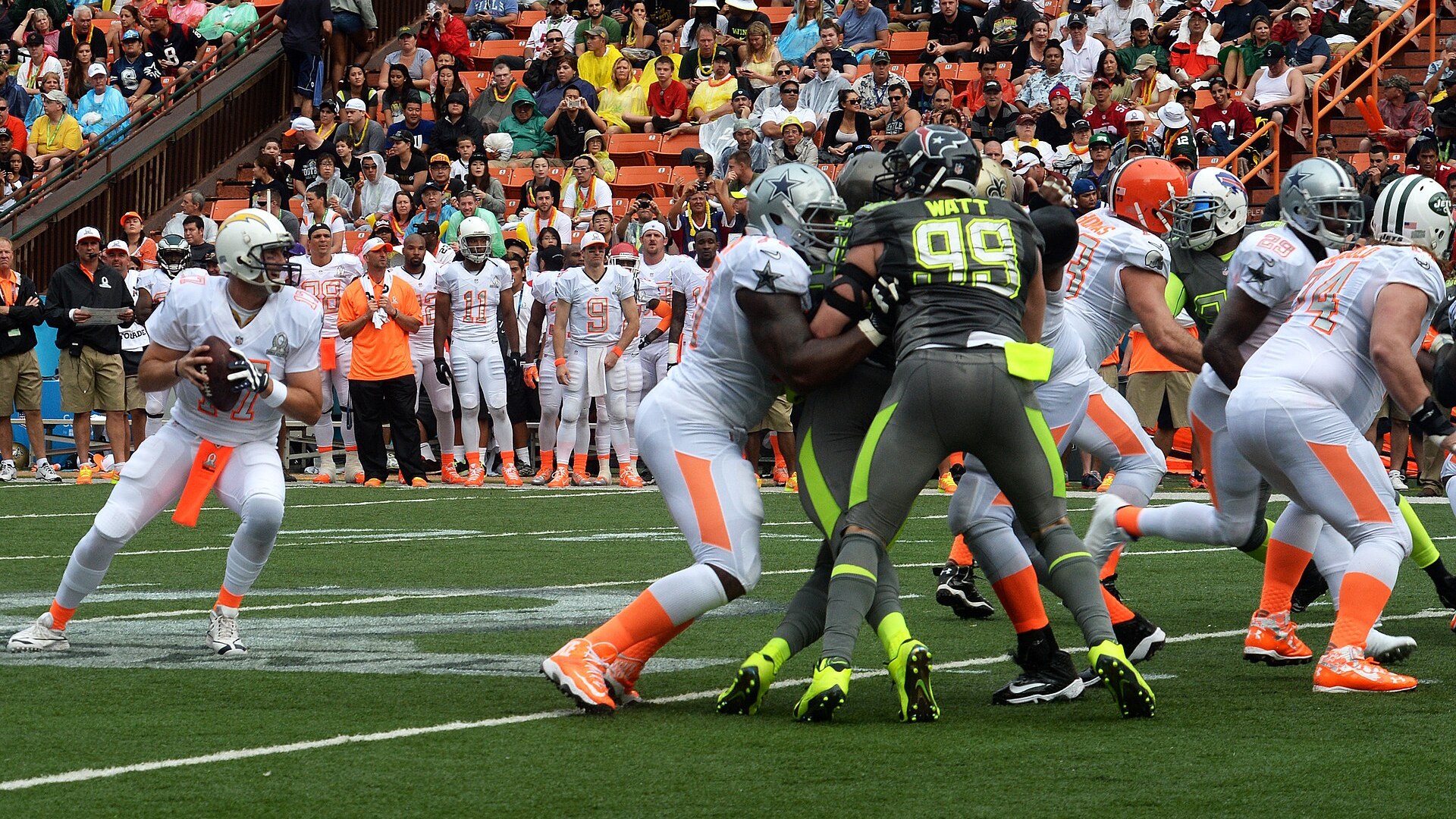
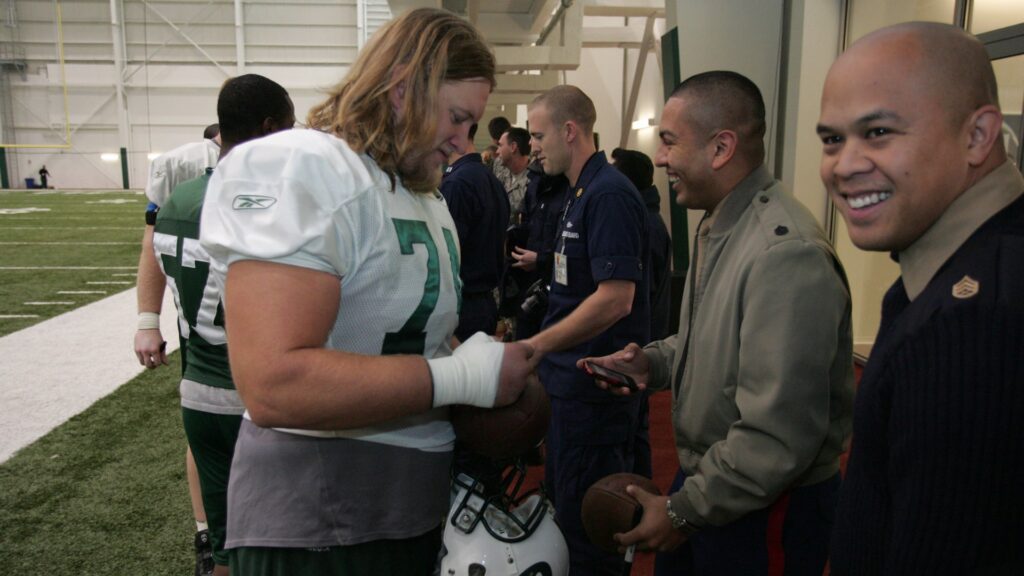
Nick Mangold, number 74 at right, in action at the 2014 Pro Bowl. Photo by Sgt. Alexander Martinez, via Wikimedia Commons.
Love From the Men Who Played Beside Him
Jets chairman Woody Johnson said Nick was more than a legendary center. He called him the heartbeat of the offensive line for a decade, and a beloved teammate whose leadership and toughness defined an era of Jets football.
Johnson offered the family condolences to Mangold’s wife Jenny and their four children, and he closed with the sentence every Jets fan feels today. Nick Mangold will forever be a Jet.
Vice chairman Christopher Johnson pointed past the football. He said it was Nick’s character, humility, and humor off the field that made him unforgettable.
Head coach Aaron Glenn, who scouted for the franchise during the Mangold years, kept it plain. A true Jet, through and through, Glenn said. He was the heart and soul of this team.
Hall of Fame cornerback Darrelle Revis, his teammate for eight seasons, wrote that he was fortunate to lace them up beside Mangold every Sunday. I will miss you and forever cherish our moments in the locker room, Revis wrote. Love you buddy.
Running back Thomas Jones, who ran behind that line for three seasons, called him one of the kindest people he ever met and one of the greatest interior linemen to ever play the game. This one hurts, Jones wrote.
Guard Damien Woody, who lined up next to him, called Mangold the best center he ever played with. And former head coach Rex Ryan broke down in tears on national television Sunday morning, calling him a great young man and saying it is just way too young.
A Sunday Nobody in Green Will Forget
The Jets announced the death about an hour before kickoff on Sunday in Cincinnati, the state where Mangold grew up. He was raised in Centerville, Ohio, about 45 miles north of the stadium where his team played that day.
A moment of silence was held in the press box before the game. The Jets then went out and beat the Bengals 39 to 38 for their first win of the season, on a day that already carried heavy news across the league.
It felt like a win he would have loved, loud and stubborn and refused until the final whistle. It also felt like one he should have been alive to see.
Why His Story Hits Home in Our Community
For Black families, the fight Mangold just lost is painfully familiar. Kidney disease does not land evenly in this country, and it never has.
The National Kidney Foundation reports that Black Americans are nearly four times more likely than white Americans to develop kidney failure. Black patients make up more than 30 percent of the people in this country treated for end stage kidney disease.
More than 90,000 Americans are sitting on the kidney transplant waiting list right now. Many will wait three to five years for a call that changes everything. Some, like Mangold, will run out of time first.
That is why his October message mattered beyond football. A famous man with every resource still had to ask the public for an organ, because that is how thin the donor pool is. His honesty put a famous face on a quiet emergency our community knows too well.
If his story moves you, let it move you toward the donor registry and toward the people in your own life quietly doing dialysis three days a week. That is the lesson he left on the table.
Mangold is survived by his wife, Jennifer, and their four children, Matthew, Eloise, Thomas and Charlotte. His sister Holley carried the family name to the 2012 United States Olympic weightlifting team.
After football he stayed in New Jersey, close to the team facility, and spent the last two seasons coaching the offensive line at Delbarton School in Morristown, teaching young linemen the craft that made him great.
Rest in peace, Nick Mangold. In our sports coverage and in the hearts of everyone who watched him work, number 74 is forever.