


Listen To This Article
Urban City Podcast Group
00:00
Sorry, no results.
Please try another keyword
Urban City Podcast Group Audio
Major Takeaways
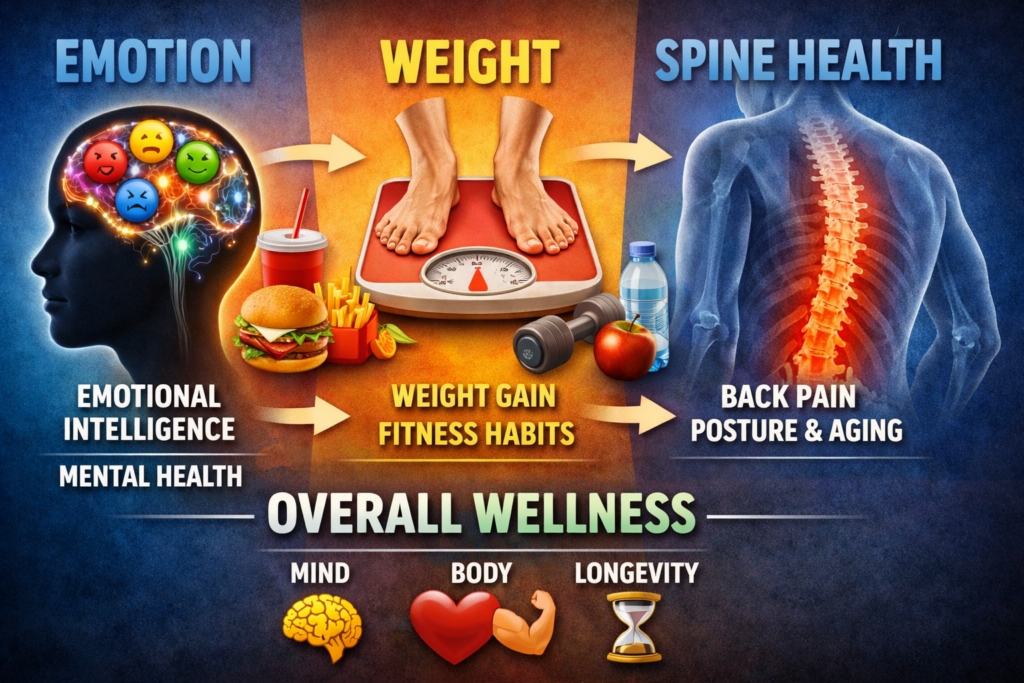
Emotional intelligence plays a major role in how people manage stress, health, and daily life decisions
• Even small amounts of weight gain can place serious long term strain on the spine and joints
• Strong emotional awareness and physical fitness together lead to better overall health outcomes
The Science Behind Happiness And Human Emotion
You’re listening to Radio Health Journal, the trusted news source for medicine, science and technology. I’m Elizabeth Westfield. I’m Mayan Vastabetancourt. And I’m Greg Johnson. This week, how those extra few pounds of weight gain are impacting your spine health. Guys tend to gain 10 pounds every 10 years. So somebody who is ultra fit in their 20s, if you think about that, could be extremely disabled in their 60s and 70s. But first, why can’t scientists agree on what emotions are? It’s a field that is characterized as much by sense of opinions than by actual facts. All that and more this week on Radio Health Journal. $5,000. That’s the average amount of money people in the U.S. are now spending on gas in a year. Five grand. That’s crazy. If you drive, you have to download Upside, the free app that gives you cash back every time you get gas. That’s right. You can earn real cash back with Upside just by buying the gas you’re already buying. You can literally start earning cash back today. I use Upside every time I fill up and I’ve already made around $200, $300. You’re putting gas in your car anyway. Why not get real cash back? If you like free money, download Upside. I’m saving the cash I earn from using Upside to help pay for a vacation later this year. Download the free Upside app now to earn cash back every time you buy gas. Use promo code NEW5 to get up to a $5 bonus on your first tank. You can cash out any time, right to your bank, PayPal, or a gift card for Amazon and other brands. Just download the free Upside app and use promo code NEW5 to get up to a $5 bonus on your first tank. That’s code NEW5 to get up to a $5 bonus on your first tank. What would you say happiness looks like? Some may point to a person who looks relaxed or content, while others would say it’s someone who’s smiling or laughing. It’s no secret that on any given day, humans feel a wide variety of emotions. While they’re present in nearly every aspect of our lives, Andrew Ortoni says we still don’t know much about them. Ortoni is a professor emeritus of psychology, education, and computer science at Northwestern University and has been researching emotions since the 1980s. He says a lot of the discussions are opinion-based because researchers can’t agree on any one theory about what emotions exactly are. However, we do know that they help us navigate our daily lives. They help organisms manage the vicissitudes of everyday life. They help them deal with problems which they’re confronted. Emotions help them learn from experience what’s beneficial, what’s potentially harmful, what’s helpful and so on. This explanation is based around one of the most prominent theories at the moment, called appraisal theory. It’s the idea that we’re constantly assessing the world around us and responding to it through our emotions. Ortoni believes that emotions are our reactions to the psychologically important situations we encounter. They can be real world things or they can be memories. They can be generated externally or internally. But they’re things that we’re processing that are important to us. Put another way, if you don’t care about something, you’re not going to have an emotional reaction to it. Emotion presupposes caring in the sense of, this matters to me, you know, this impinges on my goals and my interests and my concerns in some way, or at least I see it as so impinging. While appraisal theory is well accepted by scientists, there are still some critics. A popular debate is whether all humans have a main set of basic emotions. Many researchers say yes, but there’s still been no consensus on what these emotions are. When you say to them, well, what are your criteria for something being a basic emotion? They’ll either say, well, it’s obvious, anger, fear, happiness, sadness, and maybe a couple of others. But again, when you look at the field, the number of proposed basic emotions amongst basic emotion theorists ranges from about two to 30 or more. So again, they kind of, in one sense, they don’t agree as to what they’re talking about. My claim is they don’t even know what they’re talking about. The debate even hits on seemingly simple feelings. For example, some scientists believe hunger and thirst are emotions, while others like Ortoni think that they’re completely separate sensations. I had a long argument, oh, probably 30 years ago with a Nobel laureate who insisted that hunger was an emotion. So what are you going to do? I mean, who’s going to be the arbiter of a disagreement like that? I mean, I was astounded. I thought, my God, this guy’s got a Nobel Prize. And from my perspective, he didn’t know what he was talking about. And from his perspective, I didn’t know what I was talking about. And I mean, I don’t have any more entitlement to say I’m right than he does to say that he’s right. So that’s just an example of what I mean when I say, you know, it’s a field that is characterized as much by sense of opinions than by actual facts. And even if Ortoni’s colleagues continue this battle over basic emotions, he says it doesn’t really matter because it won’t help us advance our understanding of emotions, what they do, how they help us, or why we even have them. But with appraisal theory, Ortoni argues a potential answer to those questions. He believes our emotions are a direct and instant response to our perception of the world around us, rather than the reality. With that being said, can we change how our minds automatically respond? Ortoni doesn’t seem to think so. He believes we’re all born with our own unique emotional baseline, just like how we all differ in height, our emotional capacity does too. Clearly, to some extent, one can learn just by using tricks like, you know, count to 10 before you react. But they’re tricks and those are tricks to overcome a natural response. I mean, you’ve probably encountered people that we call sort of flat affect people, people where they never seem to react to anything, either positively or negatively. Okay, then there are other people that the slightest little thing sets them off. I mean, walking cases of extreme emotional people, doesn’t matter whether it’s positive or negative, their reactions always seem to be excessive and intense. I think these are just individual differences. There probably is just something one can do to some degree, but still you’re trying to overcome these natural innate personality characteristics. Again, this is opinion, not fact. An opinion that Nadine Leavitt challenges. She’s the author of children’s books and social emotional learning curriculums called My Mama Says Inside Me Lives a Village. Her program teaches kids how to understand and regulate their emotions in order to foster their emotional intelligence. Emotional intelligence, I think, comes in three levels. The first level is, can you identify emotions in yourself and other people? And that’s sort of the basics. The second level is, can you separate out your emotional responses from your thought patterns and behavior? So I don’t think you can control your emotional responses. So you’re going to feel angry or happy or any of those kinds of emotions. But you can control the way you think about them and the way you behave. For example, Leavitt says it’s okay to feel angry, but it’s not okay to punch someone as a response. She believes the third level of emotional intelligence is being able to recognize all of your feelings at any given time and then understand what they’re trying to tell you. Ortoni says this final skill will allow you to respond more rationally in daily situations. And though Ortoni thinks a person’s natural emotional intelligence cannot drastically change, Leavitt believes it’s something that not only can be taught, but becomes more natural over time. The more that you practice it, it’s just a habit. It’s just a skill like anything else that you learn. There’s a literacy piece to it, obviously being able to understand how emotions feel, understand how emotions look in ourselves and other people. And that’s just an awareness, right? The more we can start to point that out, the better the habits become. Leavitt says the feeling of different emotions can change depending on our situation. Feeling happy when you’re about to ride a roller coaster is usually coupled with nervousness and excitement. However, that happiness looks different when you’re on the couch with a bowl of popcorn watching your favorite movie. As Leavitt researched these variations, she realized emotional intelligence was more important than she thought. I realized that emotional processing is such a huge foundational skill for success in anything from academic achievement, professional achievement, to relationship building, to responsible decision making, self-awareness, social awareness, all of it. But what happens when you don’t process your emotions? Many of us know the feeling of ignoring certain sensations in the hopes that they’ll magically disappear. Unfortunately, Leavitt has firsthand experience of why that doesn’t work. She was in law school about to take her bar exam when a family crisis hit. My mom was super sick and sort of in and out of hospital for a good part of a year. And at one point, it looked like, you know, it was going to go south and that she was going to probably not make it. And at the time, I was sort of not going to process those emotions. I kept thinking to myself, I have to soldier on, have to be strong. I’m not going to cry. And the reason for that was just I was scared that I would break down and not be able to do any of my bar exam. I wouldn’t be able to focus on things. And so I just sort of ignored it and repressed it and then ended up with 17 stomach ulcers. Leavitt says she’s the poster child of what can happen when you refuse to process your emotions. Her curriculum teaches kids to think of their feelings like messengers. These messengers take their job seriously. So if they can’t get your attention the usual way, they’ll adjust their delivering strategy. So you’re going to start saying things like, maybe I’ll get louder or bigger somehow or make bigger movements if they’ll notice me. Or maybe I’m going to call a few more of my friends to get their attention. And maybe I’ll just go really quiet and sneak up on them and suddenly explode in their face and then they have to pay attention. All in the name of getting our attention. Leavitt says that we need to take time to process each emotion without distraction, even if it’s just for a minute. Science has proven that even with billions of neurons, we can’t multitask. So thinking that we can handle multiple emotions at once can lead to many more problems. The concept that emotions can hijack us is exactly that, that these big, big emotions that come into the hippocampus of our brain and they’re trying to be processed. And they literally, that’s when overwhelm and things like that, they shut out all ability for anyone to be able to come out of the waiting room and into the hippocampus. And so I don’t know if anyone’s ever, you know, if you’ve ever felt grief or overwhelm and things like that, but you can read the same sentence 30 times and nothing will come in. Which is why Leavitt says emotional awareness is critical for developing high emotional intelligence. She admits that she can get drawn into checking things off a list and going through the motions of life, but says the problem with living that way is that it doesn’t allow us to truly be aware of our senses. While there’s still conflicting research surrounding emotions, that doesn’t mean that humans are powerless. You can still learn how to regulate your emotions and better control how you respond to any given situation. To help in this journey, Leavitt offers a free quiz for you to check in with your own feelings on her website, emotionwonderland.com. And for more information about Ortoni’s research, the second edition of his book, The Cognitive Structure of Emotions, is available now. It’s co-authored by Gerald Klor and Alan Collins. You can find more information about Nadine Leavitt, Andrew Ortoni, and all of our guests on our website, radiohealthjournal.org. This segment originally aired in September 2022. Our writer-producer is Kristen Farrah. Our executive producer is Amira Zaveri. I’m Elizabeth Westfield. Coming up, why being skinny without muscle may be just as harmful to your health as being overweight. When a Radio Health Journal returns. That smells good, Ma. What you making? Just a little something. Collard greens, cornbread, fried chicken and peach cobbler. Some leftovers. Some leftovers. Listen, I’ve been meaning to talk to you about some new COVID information I saw online. See, because you’re always on that phone. I’m serious. I read that three out of four adults in the United States have a high risk factor for severe COVID-19. And black folks like us with certain conditions like diabetes, heart disease, mental health conditions or being 50 and older like you are at high risk. Boy, you sound like a commercial. I’m just saying. I know you love your ginger teas and essential oils. But remember, there are treatment options for COVID-19 if you ever get it again. I promise if I get sick again, I’ll call my doctor to ask about my options. I love you. I love you, too. I’m glad we had this talk. Me, too. Now get out of my kitchen. Visit wetalkwerise.com to learn more. Brought to you by Pfizer. Research estimates that one third of Americans grow up without ever being taught healthy eating habits. Even those who report they understand the basics of nutrition struggle with foundational aspects of diet, like understanding labels and tracking nutrients such as carbs and fiber. Hunter Stoller says he never considered what was healthy growing up. His diet was simply whatever was available. And I would have cereal at two in the morning because I just wouldn’t sleep. And it would be three servings of these sugary cereals that are bombs of sugar. And I wouldn’t even think anything of it. And I didn’t know anything about labels. I didn’t know what ingredients I should be looking for and avoiding. And I was 50 pounds overweight until my sophomore year of college, which was five or six years ago. And that’s when I really had my turning point and my completely 180 relationship with food. I went from not caring about food, always feeling sluggish, thinking that my acne was just, you know, a result of me living and not that anything I was doing was a consequence of it. Many people first think of how weight gain will affect their aesthetics. But as Stoller mentioned, how you look isn’t anywhere near the biggest worry when putting on weight. Dr. Christopher Good is a spine surgeon and CEO of the Virginia Spine Institute. He says that extra fat, specifically around the midsection of the body, increases the stress on your spine, bones and joints, while also pulling your body’s center of gravity forward. As we lean forward with the extra weight, that does a number of particularly bad things. Your muscles function best when you’re aligned properly, meaning when you sit or stand, your ears should be right above your ankles. And when you have extra gravity pulling the weight forward, that puts more stress on the muscles in your back. They’re essentially working overtime to hold you upright. And those muscles, they fatigue. They have a lot of trouble. The discs are the cushions in your spine. And when you carry extra weight around, it compresses those discs in the joints of your spine, which not only can increase pain from the pressure, but the more we carry around over time, the faster those things may wear out. And so, you know, a small difference over a long period of time can have a huge impact. This compression also impacts other joints like our hips and knees, which can cause major disabilities. And though many people may think this effect mainly happens with major changes in weight, Good says that even a small amount of weight gain can increase the stress on the body. There’s kind of this rule of general rule of thumb out there that they say one pound of body weight is like four pounds of stress on your spine. Some people say five. I think I like that. Is it kind of a general rule of thumb? The point is it’s not a one to one relationship. And why that’s important is even a relatively small weight gain or loss can make a pretty big difference for you. And that’s nice because it can be a little daunting to think, well, I need to lose 50 pounds. That’s scary. But if you think, well, losing 10 pounds will take 40 pounds of pressure off my back, I can make a difference with a relatively achievable goal. So while the bad news is that a few extra pounds can have a detrimental effect on our body, losing that same small amount of weight can put us right back on the healthy track. Still, it can be hard to notice an extra five pounds, especially around the holidays. And it’s not that a few pounds will ruin your health, but Good says it’s the compounding effects of continually gaining a few extra pounds every year that will ultimately cause problems. Ten pounds of weight is not necessarily a horrible problem for someone, but I tend to tell especially a lot of men I see, you know, guys tend to gain 10 pounds every 10 years, right? Like so somebody who is ultra fit in their 20s, if you think about that, could be extremely disabled in their 60s and 70s. And we have to work harder and harder with each passing decade to try and counteract that if we specifically want to feel good as we age, which we all do want that. But it’s a lot of hard work. Certain factors like muscle loss, hormonal changes and a slowing metabolism all make weight loss harder as we age, which is why Stoller is thankful he got his health on track during college. After trying and failing to lose weight by following all of the fad diets, Stoller says Weight Watchers, a weight management program, helped him create lasting change. The program taught him the foundational parts of a healthy diet he’d been missing. And that taught me how to build a balanced plate. And it really motivated me because it taught me that food is fuel and you don’t need to restrict any food. You just need to be aware of how much you’re having of certain foods. And it fully changed my relationship with alcohol, the gym. I used to hate going to the gym. And now here I am. I’m working out pretty much every day and people tell me it’s too much. But it’s what I feel the best doing. And it really is a complete 180 in my entire life. Stoller began growing an online following in college and in his senior year, he decided to become a certified health coach so that he could provide accurate information to his followers. After now helping hundreds of people with their health journeys, Stoller says one of the main mistakes people make is diving straight into the deep end. People skip the basics. They love majoring in the minors. And what I will say is there’s a few foundational steps and a framework when you want to get healthy, whether you’re starting from step zero or step 50. And those are prioritize your sleep. I wear an Oura rink and I love it. I try to get at least seven hours of sleep a night. It’s so important for your body to recover. As well as focusing on a high quality diet made up of protein and fiber. But both Stoller and Good mention that losing weight isn’t the only goal. Building muscle is an important part of this equation so that we’re not becoming frail as we age. Muscles support our body. Muscles burn more calories than fat. And so losing weight and going after cardio for that purpose is great. But we have to have some muscle building exercises in there so that we don’t get weak and frail. If you’re super duper thin with no muscle mass and you get weak bones and weak muscles, that might have as much downside for some people as actually being really overweight and getting all the joint problems that comes from that. Lifting weights is often touted as the best way to build muscle and increase strength. And while that’s true, it’s not the only option. If that sounds intimidating or boring, there are so many other options that can help get you back on a healthy path. You want to find the workouts that work best for you. And I used to be someone who only goes to the gym and strength trains. And now I’ve fallen in love with these high intensity boot camp classes. And we’ll see how long that lasts. And then who knows what the next wave will be. No matter what you choose, Good says it’s important that the exercises are building up the muscles that protect our spine, which includes the glutes and core. And I’m not talking about having a six pack. I’m talking about the deeper muscles. But doing exercises like planks, Pilates, things that strengthen our midsection go a long way to supporting our whole body, but also to slowing down kind of the rate of degeneration. Because if the muscles are strong as you use your body, it transmits less bad force into the bones and joints of the spine and the discs and things. So exercise, along with a nutritious diet and plenty of sleep, is the recipe that will keep you feeling young as you age. Stoller says it can be really helpful to find inspiration and motivation through other people on similar journeys, but stresses that no two people will have the same trajectory. There’s no one size fits all when it comes to nutrition and health as a whole. Different workouts will work for different people. Different types of diets will work for different people. Some people thrive off of vegan diets. Some people thrive off of mostly meat diets. And it’s all about finding what works best for you and not just seeing what someone’s doing online, seeing the way that they’re eating. You like the way that they look or how they say they feel. And you think you have to duplicate exactly what they’re doing. And by individuality, the idea that everyone’s preferences and everyone’s needs are different is really important. And when I work with clients, I’ve helped over 300 men and women lose weight, feel healthier or just develop a healthier relationship with food. I’ve taught many different ways of eating because there is no one size fits all. You can find more information about Dr. Christopher Good, Hunter Stoller and all of our guests on our website, RadioHealthJournal.org. Our writer-producer is Kristen Farah. Our production manager is Jason Dickey. I’m Greg Johnson. Radio Health Journal returns in just a moment. $5,000. That’s the average amount of money people in the U.S. are now spending on gas in a year. Five grand. That’s crazy. If you drive, you have to download Upside, the free app that gives you cash back every time you get gas. That’s right. You can earn real cash back with Upside just by buying the gas you’re already buying. You can literally start earning cash back today. I use Upside every time I fill up and I’ve already made around two, $300. You’re putting gas in your car anyway. Why not get real cash back? If you like free money, download Upside. I’m saving the cash I earn from using Upside to help pay for a vacation later this year. Download the free Upside app now to earn cash back every time you buy gas. Use promo code NEW5 to get up to a $5 bonus on your first tank. You can cash out anytime right to your bank, PayPal, or a gift card for Amazon and other brands. Just download the free Upside app and use promo code NEW5 to get up to a $5 bonus on your first tank. That’s code NEW5. Hey, mom, I’ve been meaning to talk to you about some new COVID information I saw online. Uh-huh. I read that black folks like us with certain conditions like diabetes, heart disease, mental health conditions, or being 50 and older, like you, are at high risk. Boy, you sound like a commercial. I’m just saying. I know you love your ginger teas and essential oils, but remember, there are treatment options for COVID-19. I promise if I get sick again, I’ll call my doctor to ask about my options. Visit wetalk.com to learn more. You know, that big bargain detergent jug is 80% water, right? It doesn’t clean as well. 80% water? I thought I was getting a better deal because it’s so big. If you want a better clean, Tide Pods are only 12% water. The rest is pure, concentrated cleaning ingredients. Oh, let me make an announcement. Attention shoppers, if you want a real deal, try Tide Pods. Stop paying for watered down detergents. Pay for clean. If it’s got to be clean, it’s got to be clean. Water content based on the leading bargain liquid detergent. Medical Notes this week. You have a bigger brain than your ancestors, and that’s good news. A study published in JAMA Neurology shows that human brain size has been steadily increasing in people born after 1930. The average volume is more than 6% greater, and the brain surface area has increased by nearly 15%. The researchers think that these larger brains may reduce the cases of age-related brain conditions like dementia, since it has more capacity to adapt to any changes. Why are kids so worried? Since the pandemic, cases of anxiety have been on the rise in young people. So how can parents help ease their children’s anxious feelings? Alyssa Farley, a professor of psychology at Boston University, says the answer may seem counterintuitive. Instead of letting your child avoid distressing situations, Farley advises parents to encourage their child to gradually face their fears. And finally, how to spend your money for maximum happiness. Loneliness has been a growing epidemic in America. Thankfully, research points to one strategy that can help. Spending money on experiences rather than material items. This method helps build and foster a social connection that could lead to more happiness overall. The work is published in the journal Behavioral Decision Making. And that’s Medical Notes this week. I’m Mayan Vastabetancourt. $5,000. That’s the average amount of money people in the U.S. are now spending on gas in a year. Five grand. That’s crazy. If you drive, you have to download Upside, the free app that gives you cash back every time you get gas. That’s right. You can earn real cash back with Upside. Just by buying the gas you’re already buying. You can literally start earning cash back today. I use Upside every time I fill up and I’ve already made around two, $300. You’re putting gas in your car anyway. Why not get real cash back? If you like free money, download Upside. I’m saving the cash I earn from using Upside to help pay for a vacation later this year. Download the free Upside app now to earn cash back every time you buy gas. Use promo code NEW5 to get up to a $5 bonus on your first tank. You can cash out anytime right to your bank, PayPal, or a gift card for Amazon and other brands. Just download the free Upside app and use promo code NEW5 to get up to a $5 bonus on your first tank. That’s code NEW5 to get up to a $5 bonus on your first tank. Thank you for joining us this week and every week as we break down the science stories you need to know. You can find all of our past segments and guests on our website, radiohealthjournal.org, or wherever you listen to podcasts. Follow us on Instagram, Facebook, and X for daily content, and tune in next week for another edition of Radio Health Journal.