


Major Takeaways
Scientific evidence shows squirting often contains diluted urine, but that does not invalidate it as a real sexual response.
Squirting is not automatically an orgasm, yet it can occur alongside or as part of orgasmic experiences for some women.
The debate reflects both biological complexity and cultural discomfort with female pleasure.
What biology, research, and real women’s experiences reveal about one of the most debated topics in sexual health.
Female squirting has become one of the most debated topics in modern sexual culture. Some people confidently claim it is nothing more than urine released during intense arousal, while others argue it is a distinct form of orgasm or a unique bodily response tied to female pleasure. The truth is not simple, not one sided, and not reducible to internet jokes or oversimplified hot takes. Science, anatomy, and lived experience all play a role in understanding what is actually happening.
When people talk about squirting, they usually mean the release of fluid from the urethra during sexual arousal or climax in some women. This detail is important because the urethra is the same passage through which urine leaves the body. That anatomical reality is one of the main reasons many assume squirting must be urine. However, the body is capable of releasing different types of fluids from the same anatomical structures depending on physiological conditions, glandular activity, and nervous system responses.
Medical researchers have studied squirting by analyzing fluid samples and using ultrasound imaging to observe what happens in the bladder and pelvic region during arousal. These studies consistently show that in many cases, the bladder fills rapidly before squirting occurs. Chemical analysis of the released fluid often finds that it contains a high concentration of diluted urine. This is one of the strongest scientific arguments supporting the idea that urine plays a significant role in squirting.
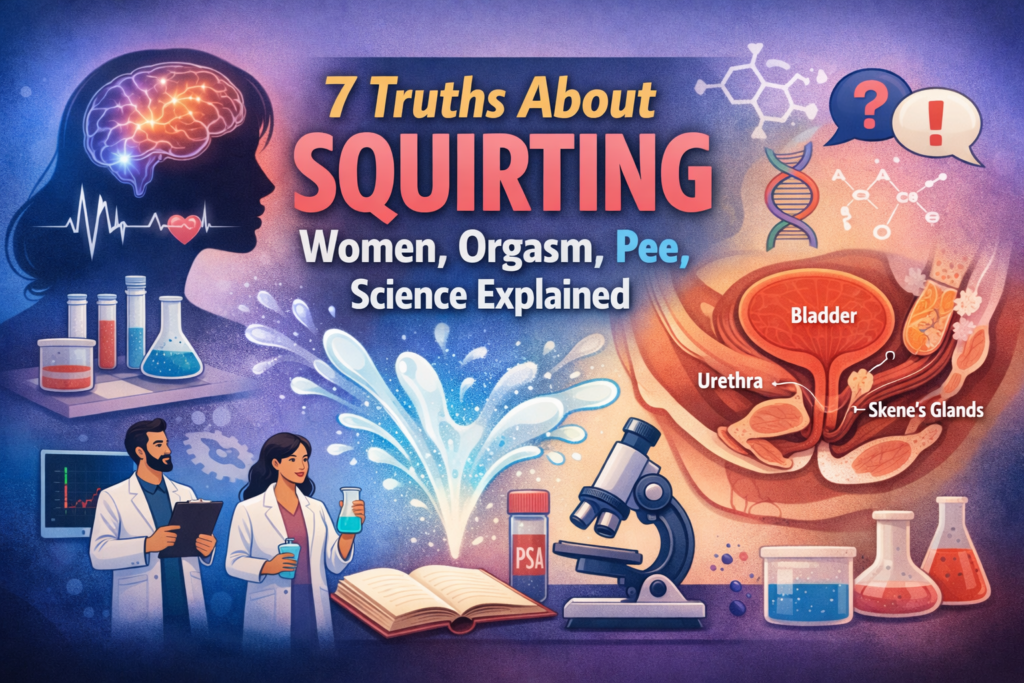
At the same time, research has also detected prostate specific antigen, or PSA, in some samples. PSA is a marker associated with the Skene’s glands, sometimes referred to as the female prostate. These glands are located near the urethra and are believed to produce secretions linked to sexual arousal. This suggests that at least some squirting experiences involve glandular contributions rather than being purely bladder output.
Because of these findings, many scientists believe there are actually two related but distinct phenomena often grouped under the same label. One involves a smaller amount of milky or whitish fluid linked to glandular secretion. The other involves a larger volume of fluid that is primarily diluted urine expelled during intense sexual stimulation. Both can occur in sexual contexts, but they are not necessarily the same biological process.
The involvement of urine does not automatically mean squirting is accidental, fake, or unrelated to pleasure. During sexual arousal, the pelvic floor muscles contract rhythmically. These contractions influence not only reproductive organs but also the bladder and urethral sphincter. Under conditions of intense stimulation, heightened nervous system activity, and deep relaxation, some women may experience involuntary fluid release. This is similar to how laughter, coughing, or other intense physical responses can sometimes override bladder control.
Importantly, involuntary does not mean meaningless. The nervous system does not distinguish between sexual muscle contractions and urinary muscle contractions as separate categories in moments of peak stimulation. Instead, the body reacts to a surge of sensory input, muscle tension, and emotional intensity.
Whether squirting counts as an orgasm is another layer of the debate. Many women describe squirting as emotionally powerful, physically euphoric, and accompanied by rhythmic pelvic contractions similar to those felt during orgasm. Some report it occurring at the peak of climax, while others experience it without reaching orgasm at all. Some orgasm without squirting. Others do both simultaneously. This variation suggests that squirting is not inherently an orgasm, but it can be part of an orgasmic response for certain individuals.
An orgasm is defined not by the presence of fluid but by neurological, muscular, hormonal, and psychological responses. Brain activity spikes, muscles contract rhythmically, heart rate increases, and dopamine and oxytocin flood the nervous system. These processes can occur with or without squirting, meaning the presence or absence of fluid does not determine whether an orgasm is real.
The argument that squirting is “just pee” often misses this broader context. Sweat is filtered bodily fluid, yet no one dismisses sweating as meaningless or embarrassing. Tears are glandular fluid, yet crying is understood as emotionally significant. The biological origin of a fluid does not define the emotional, neurological, or experiential value of the event tied to it.
Dismissing squirting as nothing more than urine also reflects a broader cultural discomfort with female sexuality. Historically, female pleasure has been under researched, misunderstood, and often minimized. For decades, scientific focus centered on male sexual response while women’s experiences were dismissed as exaggerated, imaginary, or secondary. The intensity of the squirting debate reveals not only scientific uncertainty but also lingering social unease with women’s sexual autonomy and bodily expression.
Modern sexual health experts generally agree on several key points. Squirting often contains diluted urine, but it can still be a legitimate sexual response. It is not dangerous. It is not abnormal. It is not something that needs to be fixed or shamed. The healthiest approach is not to force it into a single rigid category but to recognize it as one of many natural variations in human sexual expression.
The most accurate conclusion supported by current evidence is that squirting frequently involves urine, may involve glandular secretions, and can occur with or without orgasm. These realities do not cancel each other out. Biology and pleasure are not mutually exclusive. A response can be physiological and emotionally meaningful at the same time.
In the end, the real question is not whether squirting should be labeled urine or orgasm. The deeper issue is who gets to define women’s sexual experiences. Science can explain fluid composition, but it cannot dictate how an experience feels or what it means to the person having it. If someone experiences squirting as pleasurable, validating, or empowering, that lived reality carries its own legitimacy.
Squirting is neither a myth nor a punchline. It is a real bodily response shaped by anatomy, neurology, arousal, and personal experience. It can involve urine and still be authentic. It can be physical and emotional at the same time. And it does not need oversimplified verdicts to be understood.