
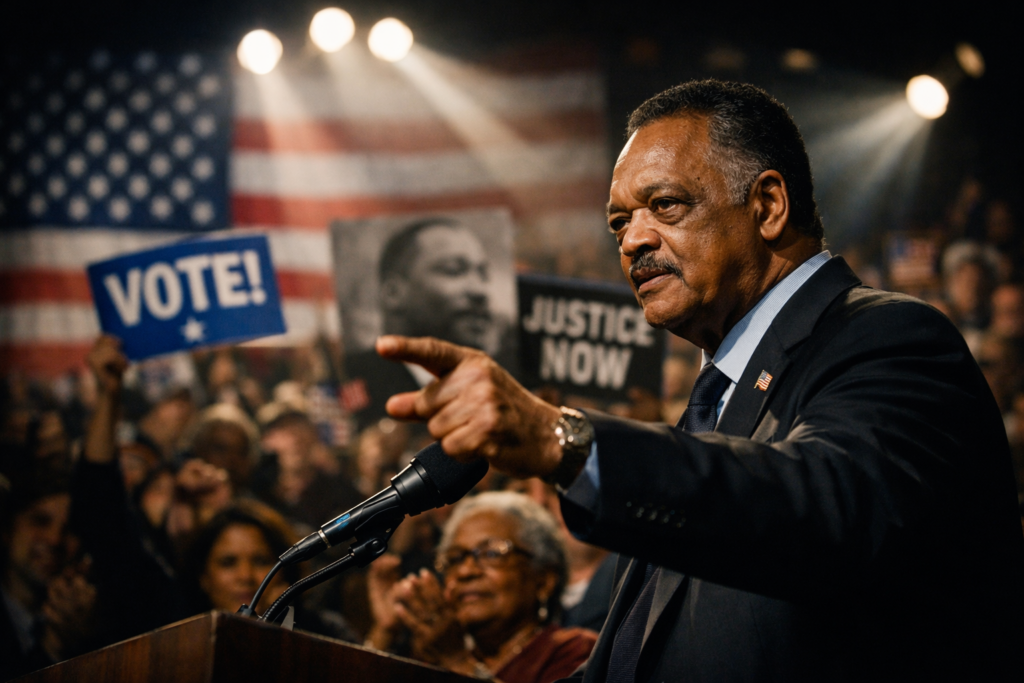

Watch this powerful episode exploring Jesse Jackson’s legacy and the civil rights battles still shaping America today. Presented by Democracy Now! via Urban City Podcast News.

This content has been republished, rebroadcast, and/or edited under the Creative Commons Attribution license (CC BY), which allows reuse, remixing, and redistribution with proper credit to the original creator. It has been enhanced by Urban City Podcast Group for educational, entertainment, and archival purposes, which may include the addition of on-screen graphics, ads, narration, or presentation formatting. — Original Creator: Democracy Now! • Source Video: https://archive.org/details/dn2026-0217_vid • License: CC BY 4.0 • Content acquired: February 22, 2026
Major Takeaways
- Rev. Jesse Jackson’s efforts toward civil rights progress were significant but incomplete
- Criminal justice and immigration remain central policy issues
- Media plays a vital role in informing the public
- Grassroots activism continues to influence national policy
- Historical understanding strengthens democratic participation
Hitting at the Heart of America’s Political and Civil Rights Crossroads
Democracy Now! on Tuesday, February 17, 2026, delivered a deeply informative episode centered on the legacy of Rev. Jesse Jackson and the continuing evolution of civil rights, political activism, and social justice in the United States.
The episode also addressed current developments in criminal justice reform, immigration policy, and political organizing.
Understanding the context behind these discussions is essential for anyone seeking a fact-based view of American democracy, racial justice movements, and the political forces shaping the country today.
The Historical Impact of Jesse Jackson
Early Life and Entry Into Civil Rights Activism
Rev. Jesse Jackson emerged as one of the most recognizable civil rights leaders in American history.
Born in 1941 in Greenville, South Carolina, Jackson rose to national prominence during the Civil Rights Movement of the 1960s.
He worked closely with Dr. Martin Luther King Jr. and became associated with the Southern Christian Leadership Conference (SCLC).
After King’s assassination in 1968, Jackson continued advocating for economic justice, voting rights, and racial equality.
Key milestones in Jackson’s early activism include:
- Organizing economic empowerment initiatives for Black Americans
- Supporting labor rights and union organizing
- Promoting voter registration efforts across the South
- Advocating for educational access and economic mobility
These efforts laid the foundation for his future political influence.
The Creation of Operation PUSH and the Rainbow Coalition
In 1971, Jackson founded Operation PUSH (People United to Save Humanity), an organization focused on economic empowerment and corporate accountability. Its goals included:
- Increasing Black employment in major corporations
- Encouraging minority business ownership
- Expanding access to education and job training
- Promoting fair hiring practices
Later, Jackson founded the National Rainbow Coalition, which aimed to unite diverse political groups, including:
- Labor unions
- Minority communities
- Women’s organizations
- Progressive activists
- Farmers and rural communities
The Rainbow Coalition played a major role in shaping progressive politics in the 1980s.
Presidential Campaigns and National Influence
Jesse Jackson ran for president in 1984 and 1988. While he did not secure the Democratic nomination, his campaigns had a lasting impact.
In 1988, Jackson won more than 7 million votes and finished second in the Democratic primary. His campaign:
- Expanded Black voter participation
- Built multiracial political coalitions
- Influenced Democratic Party platforms
- Elevated issues of economic inequality
Jackson’s presidential runs demonstrated that a Black candidate could build a viable national coalition, paving the way for future leaders.
Civil Rights Progress Since the 1980s
Legislative and Social Advances
Since Jackson’s rise in national politics, the United States has seen measurable civil rights progress.
Key developments include:
- Expansion of voting rights protections
- Increased representation of minorities in government
- Growth in minority-owned businesses
- Greater visibility of racial justice issues in national discourse
The election of Barack Obama as president in 2008 marked a historic milestone, reflecting decades of activism and coalition-building.
Ongoing Challenges
Despite progress, systemic challenges remain. Data from the U.S. Census Bureau and other federal agencies show persistent disparities in:
- Wealth and income distribution
- Homeownership rates
- Educational outcomes
- Criminal justice outcomes
For example:
- Median household wealth for Black families remains significantly lower than for White families
- Homeownership rates among Black Americans continue to lag behind national averages
- Incarceration rates disproportionately affect minority communities
These realities underscore the continued relevance of civil rights advocacy.
Criminal Justice Reform in Focus
The Evolution of Reform Efforts
Criminal justice reform has become a major political and social issue over the past decade. The Democracy Now! episode highlighted ongoing debates over policing, sentencing, and accountability.
Major developments in recent years include:
- Bipartisan support for sentencing reform
- Increased use of body cameras by police departments
- Expansion of diversion and rehabilitation programs
- Growing public scrutiny of prosecutorial practices
Federal legislation, such as the First Step Act of 2018, introduced reforms aimed at reducing recidivism and modifying sentencing guidelines.
High Profile Cases and Public Awareness
High-profile incidents involving police use of force have increased public attention on criminal justice systems. National protests in 2020 and subsequent years led to:
- Local policy reforms in multiple cities
- Calls for increased transparency in policing
- Expansion of independent review boards
- Greater media coverage of justice system disparities
These developments continue to shape political discourse in 2026.
Data Driven Insights
Research from organizations such as the Bureau of Justice Statistics shows:
- The U.S. incarceration rate remains one of the highest globally
- Racial disparities persist in arrest and sentencing outcomes
- Recidivism rates highlight the need for rehabilitation programs
Understanding these data points is essential for evaluating reform proposals.
Immigration Policy and Human Rights
Current Policy Landscape
Immigration remains one of the most debated issues in American politics. The episode discussed current enforcement policies, humanitarian concerns, and legal challenges.
Key components of the modern immigration system include:
- Border security enforcement
- Asylum processing
- Visa and residency programs
- Deportation procedures
Changes in federal policy over the past decade have affected:
- Asylum eligibility rules
- Detention practices
- Processing times for legal immigration
- Work authorization programs
Economic and Social Impact
Immigration has measurable economic and demographic effects. According to the Congressional Budget Office and U.S. Census data:
- Immigrants contribute significantly to labor force growth
- Many industries rely on immigrant labor
- Immigration influences population growth trends
- Tax contributions from immigrant households support public programs
These factors make immigration policy a central economic issue.
Humanitarian Considerations
Human rights organizations continue to monitor conditions at detention facilities and border processing centers. Issues frequently discussed include:
- Access to legal representation
- Conditions for detained migrants
- Processing delays
- Family reunification policies
These concerns remain at the center of policy debates.
Media’s Role in Shaping Public Understanding
Independent Journalism and Public Awareness
Programs like Democracy Now! represent a segment of independent media focused on investigative reporting and in-depth interviews. Independent journalism plays a critical role by:
- Highlighting underreported stories
- Providing historical context
- Interviewing subject matter experts
- Presenting alternative perspectives
A diverse media ecosystem helps ensure that multiple viewpoints are represented in public discourse.
The Digital Media Landscape
The rise of digital media has transformed how audiences consume news. Key trends include:
- Increased reliance on streaming and online platforms
- Growth of independent news outlets
- Expansion of podcast and video journalism
- Greater audience engagement through social media
These changes have reshaped how information spreads and how public opinion forms.
The Continuing Relevance of Civil Rights Leadership
Lessons from Jesse Jackson’s Career
Jackson’s decades of activism provide several key lessons:
Coalition Building Matters Successful movements often require diverse alliances across racial, economic, and political lines.
Economic Justice Is Central Civil rights advocacy increasingly focuses on economic opportunity and wealth equality.
Political Participation Drives Change Voter engagement remains a powerful tool for policy change.
Media Visibility Influences Outcomes Public awareness can accelerate reform efforts.
These principles continue to guide modern activism.
Modern Civil Rights Leaders
Today’s civil rights landscape includes a broad range of leaders and organizations working on issues such as:
- Voting rights
- Criminal justice reform
- Economic inequality
- Education access
- Healthcare equity
These efforts reflect the evolving priorities of civil rights movements.
Political Implications for 2026 and Beyond
Voter Engagement and Representation
Voter turnout and political participation remain central to democratic outcomes. Recent election cycles have seen:
- Increased early voting participation
- Expansion of mail-in voting in some states
- Ongoing debates over voter ID laws
- Legal challenges related to districting and representation
These issues will likely continue shaping elections through the decade.
Economic Inequality and Policy Debates
Economic inequality is a major focus of public policy discussions. Topics frequently debated include:
- Minimum wage laws
- Tax policy
- Housing affordability
- Healthcare access
- Student loan debt
Civil rights and economic policy are increasingly interconnected.
The Role of Grassroots Organizing
Grassroots movements continue to influence policy at local, state, and national levels. Effective organizing often includes:
- Community outreach
- Voter registration drives
- Public demonstrations
- Policy advocacy campaigns
These strategies have historically driven legislative change.
Education and Public Awareness
Why Historical Knowledge Matters
Understanding civil rights history helps contextualize current events. Key educational priorities include:
- Teaching accurate historical narratives
- Encouraging civic engagement
- Promoting critical thinking
- Supporting media literacy
An informed public is essential for a functioning democracy.
The Importance of Civic Participation
Civic participation extends beyond voting. It includes:
- Community involvement
- Public discourse
- Volunteerism
- Advocacy
These activities strengthen democratic institutions.
A Legacy That Continues to Shape America
The February 17, 2026, Democracy Now! episode highlighted how past and present intersect in the ongoing pursuit of justice and equality.
Jesse Jackson’s legacy illustrates the long-term impact of sustained activism, coalition-building, and political engagement.
As the United States moves forward, the lessons of past leaders and current movements will continue shaping the nation’s political and social landscape.
Understanding these dynamics is essential for anyone seeking a comprehensive view of American democracy in 2026.