


Major Takeaways
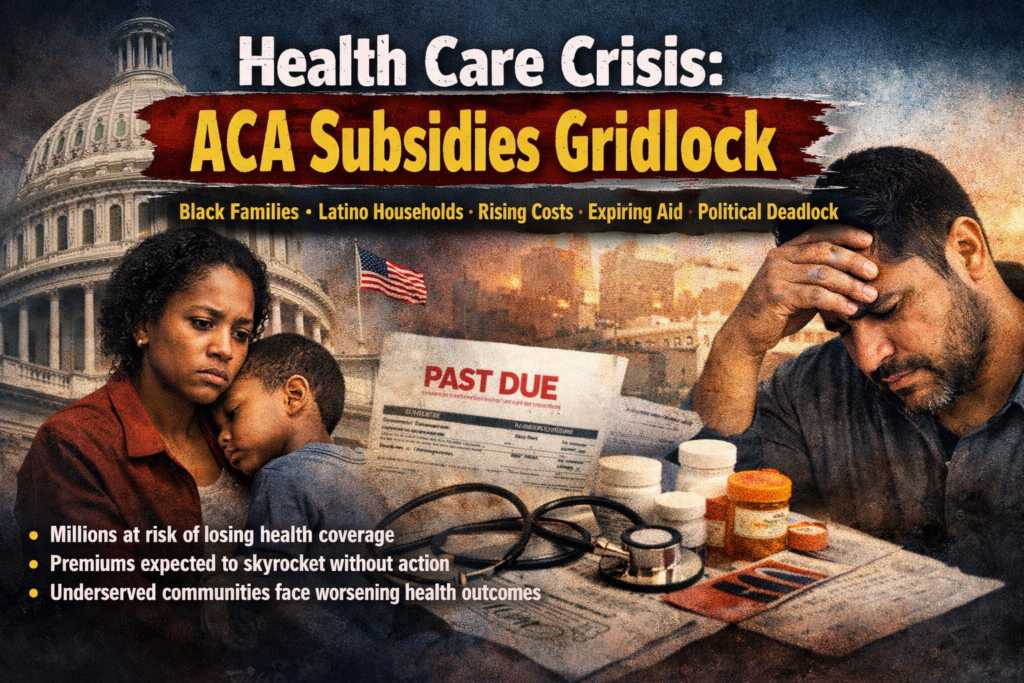
• Congress failing to extend ACA subsidies will cause premiums to spike for millions of Black and Latino families who rely on marketplace coverage
• Rising health care costs will increase medical debt, delayed treatment, and emergency room use in underserved communities
• Political gridlock in Washington is now directly threatening the health and financial stability of working class households
How Washington’s political paralysis is driving up health costs and pushing African American and Latino families toward medical debt and lost coverage
Congress is once again locked in a political stalemate over the future of Affordable Care Act health insurance subsidies, and the people most exposed to that gridlock are Black and Latino families who depend on those subsidies to stay insured. What Washington calls a budget debate is, on the ground, a fight over whether millions of working families will keep seeing a doctor, filling prescriptions, and getting preventive care or be forced back into medical debt and delayed treatment.
The ACA subsidies, formally called premium tax credits, were expanded in 2021 as part of the American Rescue Plan and later extended by Congress. These expanded subsidies lowered monthly insurance premiums for people who buy coverage through HealthCare.gov and state exchanges. They removed the income cap that once cut off help for middle income families and dramatically reduced what lower income households had to pay. For many families, monthly premiums fell by hundreds of dollars.
Those changes led to the highest health insurance enrollment in American history. More than 21 million people now get coverage through ACA marketplaces, and Black and Latino enrollment has surged. Latino enrollment increased by more than 50 percent since 2020. Black enrollment also grew sharply, reversing years of gaps in coverage. These were not abstract numbers. They represented cancer screenings, diabetes care, prenatal visits, mental health counseling, and medications that millions of people had gone without.
Now Congress is gridlocked over whether to extend those expanded subsidies past their current expiration. If lawmakers fail to act, premiums will rise automatically for most ACA enrollees. The federal government has already warned that average premiums would increase by more than 50 percent for many people. Some families would see their monthly bills double or even triple.
For African American and Latino households, the impact would be especially severe. These communities are more likely to work in jobs that do not offer employer sponsored insurance. They are more likely to be self employed, part time workers, gig workers, or employed in service and retail jobs where health benefits are limited or nonexistent. The ACA marketplace is not a backup plan for these families. It is the plan.
Black Americans have higher rates of chronic illness including high blood pressure, asthma, diabetes, and heart disease. Latino communities face higher rates of diabetes and are more likely to delay care due to cost. When insurance becomes unaffordable, these conditions do not disappear. They get worse. Delayed care leads to emergency room visits, lost workdays, and higher long term health costs.
Gridlock in Congress is not just a political failure. It directly translates into economic instability for families already stretched thin. Medical debt is one of the leading causes of financial hardship in the United States. Black families are more likely to carry medical debt and less likely to have savings to absorb surprise costs. Latino households also face higher uninsured rates when coverage becomes more expensive.
When ACA subsidies were expanded, millions of families were able to move from bare bones plans to coverage that actually worked. That meant lower deductibles, more doctor visits, and better access to prescription drugs. Losing those subsidies would force many people to downgrade to plans with higher out of pocket costs or drop coverage altogether.
The irony is that the ACA marketplace is one of the few parts of the health system that is actually working better than ever. Enrollment is high. Insurers are participating. Coverage options are broad. Yet Congress is threatening to pull the financial foundation out from under it.
The gridlock comes from a mix of budget politics and ideological battles. Some lawmakers argue that extending the subsidies costs too much. Others want to roll back what they see as government overreach. Meanwhile, families are caught in the middle. Health insurance is not a luxury. It is a necessity, especially for communities that already face higher health risks and fewer financial buffers.
The stakes are enormous. If the subsidies expire, an estimated several million people could lose coverage. Many more would be forced to choose between paying rent and paying for insurance. For African American and Latino families, that choice often comes on top of existing economic pressures like higher housing costs, lower average wages, and less access to credit.
There is also a broader community impact. When large numbers of people lose insurance, hospitals and clinics in underserved neighborhoods see more unpaid bills. That weakens already fragile health care infrastructure in Black and Latino communities. Clinics close. Services shrink. Access becomes even harder.
This gridlock also undermines public health. Preventive care like cancer screenings, vaccinations, and prenatal visits saves lives and money. When people drop coverage, they skip those services. That leads to worse outcomes and higher costs down the road, costs that taxpayers and the health system eventually absorb anyway.
What makes this moment especially frustrating is that the policy solution is straightforward. Congress simply has to extend the subsidies. They have done it before. The funding is already built into long term budget projections in many proposals. What is missing is political will.
For Black and Latino communities, the message is painfully familiar. Once again, essential services are being treated as bargaining chips in Washington. Once again, communities that already face systemic disadvantages are being asked to shoulder the burden of political dysfunction.
The ACA was designed to close gaps in health care access. The expanded subsidies made it finally start to work that way. Letting them expire would reopen those gaps almost overnight.
Congressional gridlock might sound like an inside the Beltway problem, but its consequences will show up in emergency rooms, family budgets, and kitchen tables across America. For millions of African American and Latino families, the future of their health care is now stuck in the same place as Congress itself. Stalled, uncertain, and hanging by a thread.