
Major Takeaways
Trump’s tariff threats have turned a diplomatic disagreement over Greenland into a full blown NATO crisis.
European allies see the move as economic blackmail that undermines alliance unity and international trust.
The standoff risks long term damage to transatlantic relations, military cooperation, and global trade stability.
A brewing fight between Washington and its closest allies has moved far beyond typical diplomatic disagreements and into a full blown crisis that is shaking the foundation of NATO itself. President Donald Trump has doubled down on his push toward Greenland, and in doing so, has triggered fierce backlash from European leaders who now openly accuse the United States of using economic threats as political leverage.
What makes this moment so explosive is not just the issue of tariffs, but what those tariffs represent. For decades, NATO has functioned as a collective security alliance built on cooperation, shared values, and mutual trust. Now, one of its most powerful members is threatening to punish other allies economically over a territorial dispute that most of them see as settled, unacceptable, and legally nonsensical.
At the center of the storm sits Greenland, a massive Arctic territory that is politically tied to Denmark but operates with significant autonomy. Greenland holds immense strategic value due to its location, natural resources, and military positioning in the Arctic region. Trump has long argued that Greenland is essential to United States national security, a position he first floated during his previous time in office when he suggested buying the island outright.
That idea was immediately rejected then, and it is being rejected even more forcefully now. Denmark has made it clear that Greenland is not for sale, and Greenlandic leaders have been equally firm that their future will be determined by their own people, not negotiated as a transaction between powerful nations.
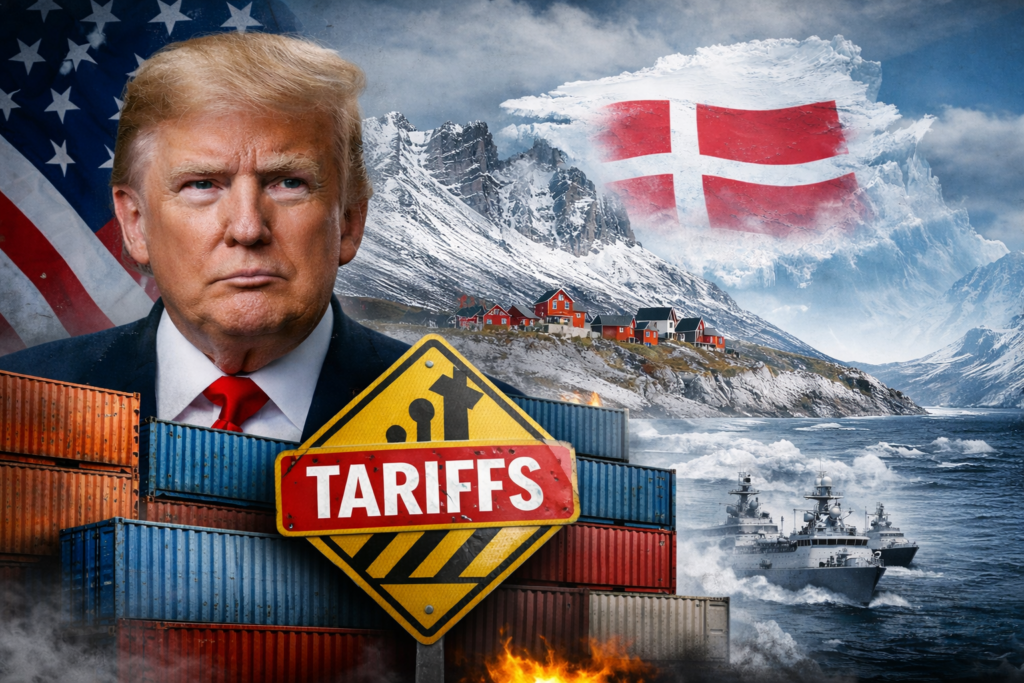
Despite this, Trump has escalated his approach by threatening tariffs against multiple European countries that are also NATO members. Beginning in February, his administration announced plans for a ten percent tax on imports from several allied nations, with a potential increase to twenty five percent if they do not cooperate with his Greenland ambitions.
European officials have not held back in their response. Many have described the move as coercive and damaging, with some explicitly labeling it blackmail. They argue that using trade penalties to force political compliance undermines the very principles that NATO was built upon.
Leaders from across Europe have come together to condemn Trump’s tactics. Countries like Denmark, Norway, Sweden, France, Germany, the United Kingdom, the Netherlands, and Finland have issued warnings that this standoff could spiral into a much larger conflict that weakens transatlantic relations. Even British leadership, which traditionally tries to maintain strong ties with Washington, has criticized the tariff strategy as misguided and disrespectful of Greenland’s sovereignty.
Beyond rhetoric, the European Union has begun preparing its own response. Officials are discussing potential countermeasures that could include retaliatory tariffs, legal action, and other economic tools designed to push back against what they see as American bullying. The message from Europe is clear. They will not accept pressure that compromises their political independence or alliance unity.
Trump, however, remains unapologetic. He has framed his stance as necessary for national security, arguing that Greenland’s position makes it vital in countering Russian and Chinese influence in the Arctic. In his view, the United States must take a stronger role in the region, even if that means clashing with long standing partners.
His rhetoric has also taken a personal turn. In recent public statements, Trump has suggested that his actions are partially motivated by perceived disrespect from foreign leaders, making the situation feel less like a calculated geopolitical strategy and more like a diplomatic grudge match playing out on the world stage.
Inside the United States, reactions have been mixed. Some lawmakers support a tougher stance toward Europe, believing that allies have relied too heavily on American protection without contributing enough to collective defense. Others, including members of both major political parties, have expressed concern that Trump’s approach is isolating the country and weakening relationships that are crucial to global stability.
A bipartisan group of American representatives even traveled to Denmark recently in an attempt to reassure Greenlandic officials that most of the United States government does not endorse the idea of forcibly acquiring their territory. Their visit highlighted how deeply divided opinions are back home.
The broader implications of this dispute reach far beyond Greenland. NATO unity is now being tested in a way it has not been in decades. Military coordination, intelligence sharing, and joint defense planning could all be affected if tensions continue to rise.
European officials worry that internal conflict within NATO benefits America’s adversaries. Russia and China have long sought to weaken Western alliances, and visible fractures among NATO members only strengthen their strategic position.
Meanwhile, NATO military exercises continue in the Arctic, reinforcing the alliance’s presence in Greenland and signaling that defense commitments remain intact despite the political turmoil. Denmark and Greenland insist that these activities are purely defensive and not aimed at provoking the United States.
The economic stakes are just as serious. If Trump follows through with higher tariffs, businesses and consumers on both sides of the Atlantic could face rising costs, disrupted supply chains, and slowed economic growth. A prolonged trade war between the United States and Europe would have ripple effects across global markets.
At the heart of this crisis lies a fundamental question. Should economic pressure be used as a political weapon against allies, or should disagreements be resolved through diplomacy and negotiation?
For Urban City Podcast readers, this moment represents a critical turning point in international relations. The outcome of this standoff will shape not only the future of Greenland, but the strength and credibility of NATO itself.
Whether this ends in compromise or continued confrontation remains to be seen. What is certain is that the world is watching closely, and the consequences of these decisions will be felt far beyond the Arctic.