
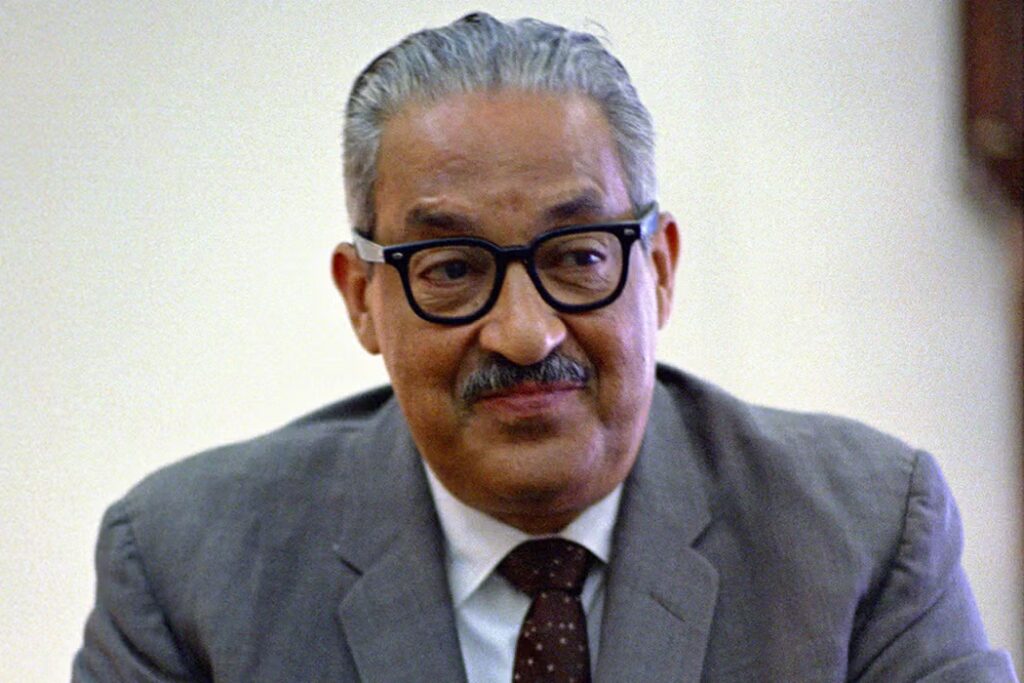
Major Takeaways
Thurgood Marshall used the law to dismantle segregation.
His victory in Brown v. Board of Education reshaped America.
As a Supreme Court Justice, he defended equality for all.
Thurgood Marshall: The First Black Supreme Court Justice Who Made Equality the Law of the Land
Thaddeus Myles here, family welcome back to Urban City’s Black Agenda, where we don’t just honor history, we put some respect on the people who forced it to move forward. Today is Day 11, and we’re stepping into the courtroom, into the Constitution, and into the mind of one of the most powerful legal architects this country has ever known: Thurgood Marshall.
Before he ever wore a Supreme Court robe, before his name was carved into the halls of justice, Thurgood Marshall was just a Black man from Baltimore with a brilliant mind and a deep understanding that laws can either protect people or be used to crush them.
He saw injustice early. Segregation wasn’t theoretical to him. It was everyday reality. Separate schools. Separate buses. Separate opportunities. And he made a decision that would ripple across American history: he would use the law to tear segregation apart piece by piece.
After graduating from Howard University School of Law, Marshall became the lead attorney for the NAACP Legal Defense Fund. That meant one thing he took on the hardest cases in the most hostile places, often risking his life just to argue that Black Americans deserved the same rights as everyone else.
He traveled across the Jim Crow South, walking into courtrooms where white judges and all-white juries already had their minds made up. He faced death threats, police harassment, and constant danger all for the simple idea that the Constitution should apply to everyone.
And then came the case that changed everything.
Brown v. Board of Education.
In 1954, Marshall stood before the Supreme Court and argued that segregated schools were unconstitutional. That “separate but equal” was a lie. That segregation didn’t just divide students it told Black children they were worth less.
The Court agreed.
With one decision, Marshall cracked the foundation of legal segregation in America. Schools. Housing. Public spaces. The ripple effects changed the entire country.
But he didn’t stop there.
Marshall argued and won dozens of civil rights cases. Voting rights. Housing equality. Fair trials. His legal record is so strong that to this day, he is considered one of the greatest lawyers in American history.
Then in 1967, President Lyndon Johnson appointed him to the United States Supreme Court, making him the first Black justice ever to serve.
And let me tell you something:
He didn’t go in quietly.
On the bench, Marshall became the conscience of the Court. He defended civil liberties, challenged racial bias, and reminded his colleagues that the Constitution wasn’t written just for the powerful it was meant to protect the vulnerable.
He wrote opinions that still shape the law today. He argued that equality wasn’t optional. That justice wasn’t flexible. That rights weren’t negotiable.
And through it all, he never forgot where he came from.
He once said, “None of us got where we are solely by pulling ourselves up by our bootstraps. We got here because somebody a parent, a teacher, an NAACP lawyer bent down and helped us pick up our boots.”
That humility. That honesty. That understanding of community that’s what made him great.
Thurgood Marshall didn’t just change laws.
He changed expectations.
He changed what Black Americans believed was possible.
Today, every civil rights case, every challenge to discrimination, every fight for equal protection under the law carries his fingerprints.
So on Day 11 of Urban City’s Black Agenda, we honor Thurgood Marshall the Unstoppable Justice who made equality the law of the land.
I’m Thaddeus Myles, and as always, keep it locked to urbancitypodcast.com and the Urban City Podcast app all month long for Urban City Podcast’s Black Agenda powered by 4AM Roastery at 4amroastery.com.